Tuesday, January 28, 2014

A Tomb For The Lost King

I’ve presented several updates on the search for and discovery of the remains of Richard III in past blogs.  Since his recovery and positive identification, a legal battle as ensued over where his last resting place should be.  I’ve followed this story closely because of my interest in British history and because my alma mater the University of Leicester led the archaeological effort to recover the remains.  The University and the City of Leicester want Richard to be reburied in Leicester.  After all, it was the Grey Friar monks of Leicester who secured his body after his death at the Battle of Bosworth Field in 1485 and respectfully buried him the Grey Friar’s church choiry where he lay (even though the church was destroyed) until February 2013. 

However, Richard was from York.  That city and the Plantagenet Society, a group of distant relatives, want him reinterred in his home town.  The law suit has not yet been settled, but plans and designs for Richard’s new tomb have already been revealed.  As you will see, a gracious nod to his Yorkshire roots is included in the design.
Re-bogged from: http://www.dailymail.co.uk/sciencetech/article-2425609/Richard-III-receive-burial-fit-king--raised-tomb-York-stone-positioned-large-white-rose.html#ixzz2riznxyOg

 
Richard III will receive a burial fit for a king under a raised tomb made of Yorkshire limestone positioned on a large white rose

By Sarah Griffiths
Richard III will be buried under a raised tomb made out of Yorkshire limestone, cathedral chiefs have announced.

King Richard III (pictured) was killed
at the Battle of Bosworth in 1485
 bringing to a close the period
of English history known as the Wars of the Roses
Leicester Cathedral said it wanted the tomb to have links that would reflect the last of England's Yorkist kings and the stone will be quarried close to where the king grew up.

The news comes amid a legal challenge by distant relatives of the King, who have questioned the decision to make Leicester the final resting place for his remains.
Plans for the raised tomb, which will be carved out of finely worked Swaledale fossil limestone and feature a deep carved cross, will now be submitted to planning officials for a final decision.

The limestone is quarried in Swaledale, Yorkshire, near to Middleham, where Richard III underwent his boyhood training in knighthood and later made his home.
Set within the cathedral's chancel, the £1.3 million project will see the tomb placed on a floor inlaid with a large Yorkist white rose.

 
The Dean of Leicester, the Very Reverend David Monteith (centre) and The Bishop of Leicester Tim Stevens (right) pose with plans for the tomb of King Richard III in Leicester Cathedral
 http://www.dailymail.co.uk/sciencetech/article-2425609/Richard-III-receive-burial-fit-king--raised-tomb-York-stone-positioned-large-white-rose.html#ixzz2rj98UWEa
The name of the King, his date of birth and death, along with his personal motto Loyaulte me Lie (Loyalty binds Me) and his boar badge will also be carved into a dark circular band around the tomb.

The project will also see changes to internal layout, windows and lighting in the cathedral.
The plans revealed today will now be reviewed by the Cathedral Fabric Commission for England, with a decision expected later this month.

If all goes to plan, the cathedral hopes the king's remains can be re-interred in a ceremony full of pomp next year.

But the plans also rely on the outcome of a legal challenge from a group of distant relatives of the king, who call themselves the Plantagenet Alliance.

They have applied to the High Court for a judicial review into the decision to grant the city cathedral licence as the final resting place for the King's remains and want to see the remains placed in York, where Richard had strong links.
Richard's remains were discovered by archaeologists from the University of Leicester after a dig in a city centre car park following a campaign by the Richard III Society and with the permission of Leicester City Council, which owned the plot of ground.

The Dean of Leicester, The Very Rev David Monteith, said: 'We fully respect the process of the Judicial Review which will ensure the procedure leading to the re-interment is correct.
'While this takes its course, we must, as would any Cathedral in this position, seek planning permission for the detailed and costly changes which need to be made to the building.

'The overall concept is regal and respectful in its elegant simplicity, as befits the final resting place of a king of England.
'By placing the tomb in our chancel, we are giving king Richard the same honour as did those friars more than 500 years ago.'

Richard III was killed at the Battle of Bosworth in 1485 bringing to a close the tumultuous period of English history known as the Wars of the Roses.
 
Richard's remains (pictured) were discovered by archaeologists from the University of Leicester after a dig in a city centre car park following a campaign by the Richard III Society and with the permission of Leicester City Council, which owned the plot of ground
Side Bar:
RICHARD III WAS RIDDLED WITH ROUNDWORMS, HIS REMAINS REVEALED

Richard III not only had a hunchback but he also suffered from roundworm infection, research recently revealed.

Scientists found roundworm eggs in a soil sample taken from the pelvis of the skeleton of the king.

Since the body of King Richard III was found, scientists have been undertaking careful analysis of the remains, in an attempt to shed further light on the attributes and history of the controversial king.

A team of researchers led by Dr Piers Mitchell, of the Department of Archaeology and Anthropology at the University of Cambridge, used a powerful microscope to examine soil samples taken from the skeleton’s pelvis and skull, as well as from the soil surrounding the grave.
The microscope revealed multiple roundworm eggs in the soil sample taken from the pelvis, where the intestines would have been situated in life.

However, there was no sign of eggs in soil from the skull and very few eggs in the soil that surrounded the grave, suggesting that the eggs found in the pelvis area resulted from a genuine roundworm infection during his life, rather than from external contamination by the later dumping of human waste in the area.

Dr Mitchell said: 'We would expect nobles of this period to have eaten meats such as beef, pork and fish regularly, but there was no evidence for the eggs of the beef, pork or fish tapeworm. This may suggest that his food was cooked thoroughly, which would have prevented the transmission of these parasites.'
Dr Jo Appleby, lecturer in human bioarchaeology at the University of Leicester, said: 'Despite Richard’s noble background, it appears that his lifestyle did not completely protect him from intestinal parasite infection, which would have been very common at the time.'


Tuesday, January 7, 2014

"He Truly Died Game" The Story of David O Dodd

January 8th will mark the 150th anniversary of the execution of David O. Dodd.  Dodd has been hailed as a "Confederate Martyr" and the "Boy Hero of the Confederacy."  But was this young man truly a martyr or simply a teenage boy who was the victim of his times? 

David Owen Dodd was from an Arkansas family, although he was born in Texas to a restless father.  Andrew Dodd took his family southwest from their home near Benton, Arkansas to the new state of Texas in 1846.  Andrew, who was always searching for a path to quick riches, moved his family back to Arkansas in1858 when he fell on hard times. 

The only known photo of David O. Dodd
At the beginning of the Civil War Andrew moved his family again, this time to state capitol of Little Rock.  Young David, who was described as slight in build but handsome, attended school at St. John's College.  From all accounts he was very popular among the young people in the city.  He found work at a telegraph office in his spare time.  He could not know it then, but the skills he learned there would play a part in his downfall.

In the summer of 1862, Andrew and David left the rest of the family in Little Rock and traveled to Monroe Louisiana.  David found employment at local telegraph office while his father criss-crossed Louisiana and Mississippi on a series of speculative trading schemes.  By late November 1862, Andrew had somehow secured the position as regimental sutler to the 12th Battalion, Arkansas Sharpshooters then encamped with the Confederate Army near Granada Mississippi.  Andrew summoned his son to Granada.  For three months, David was left in charge of the sutler store as his father traveled across the south buying and selling goods as part of another get rich scheme.

St. John Masonic College, Little Rock.  Where David O. Dodd attended school and would later be executed.
The spring of 1863 saw the military situation in Mississippi deteriorate for the Confederates and US Grant began his long campaign to capture Vicksburg.  Andrew and David headed back to Arkansas as the fighting intensified and the Confederate Army backed itself in the trap at Vicksburg.  With the fall of that river fortress on July 4 1863, the Federals turned their attention to Arkansas.  Little Rock fell to Federal forces under the command of General Fredrick Steele on September 10, 1863.

Andrew again leaned on David to carry out his responsibilities.  He feared for his safety if he crossed Union lines, so he sent David to Little Rock to escort his mother and sisters from that city to Jackson Mississippi.  David arrived safely, but for several reasons Mrs. Dodd decided not to make the journey to Mississippi.  Her son fell back into a routine in Little Rock, reacquainting himself with old friends including several young ladies.
General Fredrick Steele
Commander of the District of Arkansas


 Ironically, his experience operating a sutler store in the Confederate Army, led him to employment working for similar establishments for the Federal forces.  He worked, at various times, for the sutlers of the 10th Illinois Cavalry, 1st Missouri Cavalry and later the 43rd Illinois Infantry, all regiments quartered in Little Rock.  Through these establishments, David made several friends in the Union regiments that occupied the capitol city. 

By early December 1863, Andrew Dodd finally gathered his nerve and came to Little Rock to retrieve his family.  His stay was short, only long enough to load his family and some belongings in a wagon and start south to Camden Arkansas, where most of the Confederate Army in Arkansas was operating. 

Soon after arriving in Camden, Andrew Dodd cooked-up a new financial scheme.  The War had disrupted tobacco production and trade in the south.  He was sure that prices would rise tremendously as the War dragged on.  He hoped to buy up large supplies of tobacco and hoard it until the market demanded premium prices.  But, he lacked the funds to finance his idea.  Back to Little Rock, he sent David where he was to meet with Andrew's old business acquaintances who might invest in the venture.
To pass back out of Southern lines, David required a pass from the Confederate military.  Andrew procured just such a pass for David along with an affidavit proving his age and place of birth (at age 17, David was not yet of age to be conscripted into the Rebel Army.)  He traveled north, passed un-noticed through the Federal lines and entered the city on Christmas Eve.


David immediately delivered the letters concerning the tobacco venture to his fathers business associates and then went to his aunt's home where he was to lodge during his stay.  On Christmas day he visited Mary Dodge, daughter of Dr R.L. Dodge delivering letter to her for his sisters.  Mary and David then spent the day visiting other young people in the city.  The day after Christmas, David attended a party where he escorted Miss Minerva Cogburn home after the festivities.  He had planned on leaving for Camden on the afternoon of December 28, but instead stayed one more night to attend yet another holiday party with a young lady named Mary Swindle. 


CS General James Fagan
David mounted his mule and set out for Camden on December 29th along the road to Benton know as the Stagecoach Road at the time,  now known as Colonel Glenn Road.  A picket of the 1st Missouri Cavalry stopped him eight miles from town, near where David O. Dodd Elementary School stands today.  He produced a pass which he had obtained from the Union Provost Marshal.  The soldier inspected his pass and then confiscated it explaining that he would no longer need it as was leaving Union lines and there were no more picket posts further ahead.

The next stop was the home of David's uncle, Washington Dodd.  There he retrieved a small pistol and some other belongs that he was to transport to his father in Camden.  He set off again but was surprised by another picket post of the 1st Missouri Cavalry - a picket post that was not suppose to be there according the soldier who confiscated his pass.

When no pass could be produced, the soldiers searched David, found the pistol and a note book with a curious series of dots and dashes - Morse code.  An officer there recognized the code and was just literate enough in Morse to decipher descriptions of troops strengths and locations.  A further search revealed his Confederate pass and his birth certificate.  The soldiers arrested David. 

The next morning an escort took David to the headquarters of General John B. Davidson, then the garrison commander of Little Rock.  Davidson immediately called for a telegrapher and Captain Robert C. Clowrey (future president of the Western Union Telegraph Company) to decipher the code.  Captain Clowrey began to read:

"3rd Ohio Battery has 4 guns -brass.
11th Ohio Battery has 6 guns -brass

Three brigades of Cavalry in a Division. Three in a brigade, brigade commanded by Davidson.
Infantry: 1st has 3 regiments. 2nd Brigade has 3 regiments, one on detached -1 Battery 4 pieces Parrots Guns.

Brig. General Solomon Commands a Division, two brigades in a Division; three regiments in one brigade. Two in the Two Batteries in the Division."

One of the letters being carried home to one of the Dodd sisters ended with a question.  "I shall be very anxious to hear how Davie got through."  David also possessed a pass from Confederate Colonel Crawford.  Seventeen year old David O. Dodd was arrested and charged with being a spy.
David's trial began on December 31 1863.  The president of the military commission conducting he trial was General John M. Thayer whose post war career would include US Senator, Governor of Nebraska and Governor of the Wyoming Territory.  The commission was made up of various regimental commanders from the occupying forces.  Two prominent local lawyers, T.N. W. Yonley and William M. Fishback (later governor of Arkansas) volunteered to provide a defense for the young man.

General John M. Thayer
William M. Fishback
 The trial progressed over two days.  Yonley and Fishback realized that the evidence against their client was overwhelming and developed a plea arraignment which stipulated that Dodd would swear an oath of allegiance to the US which would grant him a pardon as stipulated in a Proclamation of Amnesty the President Lincoln had issued earlier in the month.   The commission deliberated and ruled that the Proclamation did not apply in cases of espionage.  The defense fell on the mercy of the court providing witnesses who testified to David's good character and solid record.  David even submitted a written appeal that stated in part: 
"I have just entered upon the threshold of life; and in the midst of its green fields and inviting flowers, I have not had either the time or the inclination to dream of treason and of stratagem. . . Above all, Oh My Judges, will you hear the of my mother's words prophetic of my own emotions. She has rejoiced I was a minor, and unable to bear arms against the flag of the Union."

 The commission could deliver no other finding than guilty, although the members of the commission may have been unaware that they had no control of the punishment brought on by their sentence.
The verdict was guilty and the sentence was hanging.  The US Congress had passed a law that required capital punishment for all acts of espionage.  General Fredrick Steele, commander of the District of Arkansas, had no choice but approve the sentence.  David O. Dodd was sentence to die by hanging on January 8, 1864.

By mid day on January 8 people started to gather on the parade grounds of St. John's Masonic College, where David had attended classes.  A simple scaffold with two tall posts and a cross bar were erected.  Earlier that morning David asked to see General Steele and the old soldier visited the young man at the military prison.  There David made one last plea and explained that Confederate General James F. Fagan had required him to gather intelligence in exchange for passage through the lines to Little Rock.  (General Fagan later denied ever speaking with David.)  Steele was powerless to change the sentence, however.  The boy wrote one last letter to his family.

Military Prison
Little Rock, January 8   1030 o'clock am 1864

 My Dear Parents and Sisters
I was arrested as a Spy and tried and was Sentenced to be hung today at 3 o'clock   the time is fast approaching but thank God I am prepared to die   I expect to meet you all in heaven   do weep for me for I will be better off in heaven   I will soon be out of this world of sorrow and trouble   I would like to see you all before I die but let Gods will be done not ours   I pray to God to give you strength to bear your troubles while in this world    I hope God will receive you all in heaven   Mother I know it will hard for you to give up your only son but you must remember it is Gods will   

 Good by God will give you strength to bear your troubles   I pray that we may meet in heaven    Good by   God will bless you all your Son and brother
David O. Dodd

 A hollow square of soldiers formed around the scaffold.  A regiment on each side were assembled to witness the execution and to provide security should the crowd of six thousand civilians create trouble.  Little Rock only recorded four thousand inhabitant in the 1860 census, but the war had swelled the town to bursting.  It seemed that everyone in town turned out for the event, all except David's close friends.  Most could not bear the spectacle. 

Just before 3:00 pm a wagon rolled into the hollow square of soldiers.  David rode in the back, seated on his own coffin.  The tailgate of the wagon was lowered directly under the scaffold and the boy was asked to stand upon it as the noose was fitted around his neck and his arms tied behind his back.  The executioner patted his pockets and fumbled about looking for a misplaced blindfold.  David politely offered:  "You will find a handkerchief in my coat."  The hushed crowd watched as the youth stood with perfect calmness and dignity. With David's own handkerchief tied around his eyes, the executioner cut the rope holding up the tailgate. 

David O. Dodd was not a tall boy, but the rope began to stretch and his toes touched the ground.  several soldiers rushed to pull up the rope to prevent a lingering death, but by then his neck had broken.  One soldier who witnessed the execution wrote later:  "David O. Dodd met the king of terrors with a perfect coolness I never saw equaled."  Another remarked: "I never saw a man so determined in my life, and he truly died game."

Much has been written about David O. Dodd through the years.  Many of the stories were embellished or contrived by Southern apologists to promote his image as a Confederate Martyr.  One of the most repeated is that General Steele offered him freedom if he would reveal his source of information.  Steele had no power to offer such a deal.  Another story suggests that one of the three young ladies he visited in town gave him the information, but he would not betray her to the Federals.  Many other erroneous accounts attribute Nathan Hale style speeches to him at the time of his hanging, words that no one present ever recorded.  No one can doubt, however that David O. Dodd went to his death with extreme dignity and courage.

David did not need a secret source for the information to smuggle out of Little Rock.  It could have been gathered in simple conversation with the Union soldiers in town that he had befriended.  His time serving as a sutler in the Confederate Army would have given him enough basic understanding of military organizations to be able to ask simple questions without attracting too much attention.  I think a better question is what his motivation may have been and why he chose to take the risk of gathering intelligence and crossing the lines with it.  More importantly, once he decided to do so, why was he so clumsy in his methods?  David took all that to the grave with him.

Mount Holly Cemetery was the most prominent cemetery in Little Rock at the time of the War.  A wealthy donor offered up a plot there for the young man, and the citizens of the town collected funds to provide a substantial memorial to him in the immediate post war years.  The inscription to him is repeated very fittingly in Morse code.  Each year, the Sons of Confederate Veterans and the United Daughters of the Confederacy hold a special memorial ceremony for him at Mount Holly.
The memorial to David O. Dodd at Mount Holly Cemetery. 
The inscription is repeated in Morse code.
Inscription on the foot of the memorial. 
The citizens of Little Rock collected funds for this memorial after the Civil War

You can read a more detailed account of David O. Dodd here:
http://www.harding.edu/jndockery/Harding/HIST_336_files/FISCHER%20DAVID%20O.pdf


Friday, December 13, 2013

Stokesay Castle - To Protect Against the Marauding Welsh

Stokesay Castle is one of my favorite castles in the United Kingdom.  It is also the smallest.  Its remarkable preservation is what makes this jewel special.  The castle, which is actually a heavily fortified manor house sits near the Welsh border in western Shropshire.  The valley where it is situated was one the major thoroughfares across the Welsh Marches were bands of Welsh sometimes crossed the border to prey on English farms and manors.

The castle complex now consists of a tower keep, a great hall, a curtain wall that surrounds about one acre and a curious Tudor style gate house that was added in the 1600s.  Unfortunately, several small out buildings within the curtain walls have been lost to time.  Stone foundations in the soil mark where they once stood.  The level of preservation of this remarkable place is for two reasons.  First is the poverty that owners endured in the years after the Civil War.  That lack of funds did not allow remodeling or changes that occurred in more affluent manors through the years.  The second is the foresight of the Allcroft family who purchased Stokesay in 1896.  They took enormous care to restore and preserve the castle in its original form, although the retained the gate house and other additions that date from Tudor times.


Stokesay Castle is really a 13th Century fortified manor house.  The tower was constructed in 1240 by the de Say family.  The tower was built in a village known as South Stoke. This was later added to the family name - Stoke-de-Say.  It was a wild and lawless time on the border in those years hence the need for the tower and a small moat around the whole village.  Work on a Norman church was also began at the same time. 
From: Castles From the Air: An Aerial Portrait of Britain's Finest Castles.
 
The following is from the English Heritage web site for Stokesay Castle.  More information and additional photographs can be found there. 

http://www.english-heritage.org.uk/daysout/properties/stokesay-castle/

Stokesay Castle is quite simply the finest and best preserved fortified medieval manor house in England. Set in peaceful countryside near the Welsh border, the castle, timber-framed gatehouse and parish church form an unforgettably picturesque group.


Lawrence of Ludlow purchased the property in 1291 and began to fortify the manor in earnest.  He added a great hall, and received permission from Edward I to crenelate (build curtain walls).  The curtain wall enclosed the courtyard and rose 30 feet above the moat. During the Civil War, Parliamentarian Forces captured the castle and destroyed the defensive crenelations on the wall.) Lawrence of Ludlow's family lived at Stokelay for 300 years. This illustration from the English Heritage web site shows how Stokesay may have looked during Lawrence of Ludlow's time.
Lawrence of Ludlow, a wealthy local wool-merchant wishing to set up as a country gentleman, bought the property in 1281, when the long Anglo-Welsh wars were ending. So it was safe to raise here one of the first fortified manor houses in England, 'builded like a castle' for effect but lit by large domestic-style windows. Extensive recent tree-ring dating confirms that Lawrence had completed virtually all of the still surviving house by 1291, using the same team of carpenters throughout: more remarkably, the dating also revealed that it has scarcely been altered since.


The stone stairway in the 60 foot tower is unusual in that it wind down clockwise instead of counterclockwise.  Most are done in the opposite manner so a right handed defender can more easily wield his sword. Photo by author.


An arrow slit defends the moat with a view west to the Welsh border.  Photo by author
 
Stokesay's magnificent open hearthed great hall displays a fine timber roof, shuttered gable windows and a precipitous staircase, its treads cut from whole tree-trunks. It is flanked by the north tower, with an original medieval tiled floor and remains of wall painting, and a 'solar' or private apartment block, and beyond this the tall south tower - the most castle-like part of the house, self-contained and reached by a defensible stairway.


The Great Hall adjacent to the Tower Keep.  The hall was were most manor business was conducted, meal taken, guests lodged and where servants slept.  It has been alter little since it was built in 1291.  As is normal for that time frame, there is not fireplace or hearth.  An open fire was usually built on the floor in the middle of the hall.  Large Gothic windows open to the courtyard to let in light. Photo by author.

Inside the Great Hall.  The oak timber rafters are original as is most of the slate roofing. Photo by author.


View from inside the Great Hall across the courtyard to the Gate House.
The door still has its giant iron reinforced oaken door.
Photo from: http://www.english-heritage.org.uk/daysout/properties/stokesay-castle/

An opposite view across the Great Hall to the stairs to the living quarters.   Photo from: http://www.english-heritage.org.uk/daysout/properties/stokesay-castle/

The solar block contains one of the few post-medieval alterations to the house, a fine panelled chamber. Its dominating feature is a fireplace with a richly carved overmantel, still bearing the traces of original painting in five colours. This was added in about 1641, at the same time as the truly delightful gatehouse: an example of the Marches style of lavishly showy timber-framing, bedecked with charming carvings of Adam and Eve.


The Solar.  This room is in between the Great Hall and the Tower.  This is where the Lady of the manor and her hand maids would have spent their time, sewing, embroidering and gossipping.  These type room were called solars because they normally provided good light through large windows. Photo from: http://www.english-heritage.org.uk/daysout/properties/stokesay-castle/
This Amazing carved mantle was added to the solar during upgrades to the living quarters in the 17th Century. 
Photo by author.

 
Before the 17th Century additions, a smaller defense tower was positioned at the south end of the Great Hall.  In the 1640s it was converted to living quarters.  The top of the tower did not offer enough floor space, so these added apartments seem to hang from the side of the structure.  Photo by author.
 
The Gate House entrance to Stokesay was added along with other improvements in the 17th Century.  It seem out of place next to the 13th Century buildings, but adds a unique charm.  Photo by author.
The 17th Century Gate House from the top of the Tower. Photo by author.
 
One of the many 17th Century wood carvings that still decorate the Gate House.  Photo by author
A few years later, in 1645 Stokesay experienced its only known military encounter, surrendering without fighting to a Parliamentarian force. So the house remained undamaged, and sensitive conservation by Victorian owners and English Heritage have left it the medieval jewel which survives today.
 
No visit to any English Heritage site is complete without a spot of tea, and a scone, jam and clotted cream!


Tuesday, November 26, 2013

My Sorrow Knows No Limit


In 2000 a unique archaeological find in Andong City Korean captured the imagination of the Korean people.  The archaeological site was a tomb with a remarkably preserved mummy.  At 5 foot 9 inches he was tall for his people, especially in his day.  His dark hair and dark mustache were still intact.  Eung-Tae died in 1586, four hundred and twenty seven years ago.


Archaeologists in Andong City, South Korea, unwrap cloth covering the
16th-century mummy of Eung-tae, a member of Korea's ancient Goseong Yi clan.
  http://archive.archaeology.org/1003/abstracts/korea.html
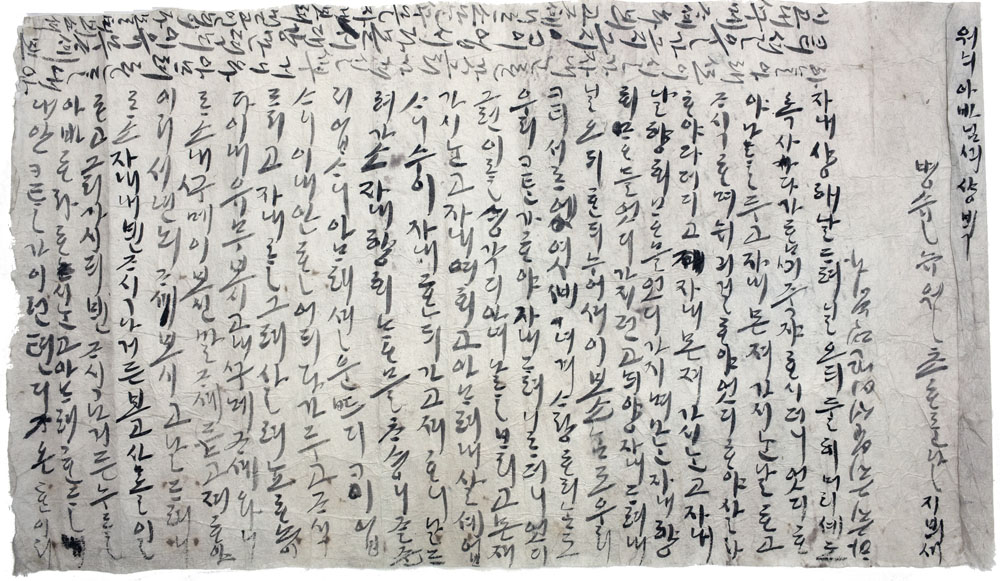
A well preserved mummy is a rare find in Korea, but what was found with him is what has captivated the imagination of the Korean people.  Thirteen letters and notes addressed to Eung-Tae were found with him in his tomb, all written by his pregnant wife whose identity had been lost.

These poignant notes remind us that the human heart is timeless.  It knows no cultural, geographical or generational bounds.  The emotions that this young wife pours from her heart into her eulogies remind us that our ancestors and the people who lived in the past did so with real heart and real emotion.  They were not simply characters in a history book.  
One note was found on a paper bundle containing a pair of sandals woven from the grieving  widow's hair.  She wrote: “with my hair I weave this” and “before you were even able to wear it.”


The sandals woven from Eung-Tae's bride from her own hair
http://web2.uconn.edu/strawsandals/?p=372


Of all the notes left to Eung-Tae, the one lovingly laid upon his chest is the one most remembered.   The translation to English from archaic Korean has diminished the poetry that was once in the lines, but the love and loss is still very clear.


To Won's Father

June 1, 1586

You always said, "Dear, let's live together until our hair turns gray and die on the same day." How could you pass away without me? Who should I and our little boy listen to and how should we live? How could you go ahead of me?

How did you bring your heart to me and how did I bring my heart to you? Whenever we lay down together you always told me, "Dear, do other people cherish and love each other like we do? Are they really like us?" How could you leave all that behind and go ahead of me?

I just cannot live without you. I just want to go to you. Please take me to where you are. My feelings toward you I cannot forget in this world and my sorrow knows no limit. Where would I put my heart in now and how can I live with the child missing you?

Please look at this letter and tell me in detail in my dreams. Because I want to listen to your saying in detail in my dreams I write this letter and put it in. Look closely and talk to me.

When I give birth to the child in me, who should it call father? Can anyone fathom how I feel? There is no tragedy like this under the sky.

You are just in another place, and not in such a deep grief as I am. There is no limit and end to my sorrows that I write roughly. Please look closely at this letter and come to me in my dreams and show yourself in detail and tell me. I believe I can see you in my dreams. Come to me secretly and show yourself. There is no limit to what I want to say and I stop here.


A photo of the love letter to Eung-Tae.  From: http://archive.archaeology.org/1003/abstracts/korea.html


Friday, November 8, 2013

America's Largest Mass Grave


This story is a bit of a departure from my usual postings.  Hart Island is not an archaeological site and not a tourist destination. (Although it has the potential to become both someday.)  It is a historic site on many levels, but it is not appreciated or interpreted as such.  I had never heard of Hart Island, and evidently that is true even for most New Yorkers.  "Mass Grave" may be an overstatement as each burial was in individual coffins.  However, the graves are dug in "mass" fashion with long trenches to hold hundreds of bodies at a time.  I find this story fascinating and re-blog it in its entirety below.

What We Found at Hart Island, The Largest Mass Grave Site in the U.S.
 
By - Kelsey Campbell-Dollaghan, November 7, 2013

It’s a place where few living New Yorkers have ever set foot, but nearly a million dead ones reside: Hart Island, the United States’ largest mass grave, which has been closed to the public for 35 years. It is difficult to visit and off-limits to photographers. But that may be about to change, as a debate roils over the city’s treatment of the unclaimed dead. Never heard of Hart? You’re not alone—and that’s part of the problem.

 
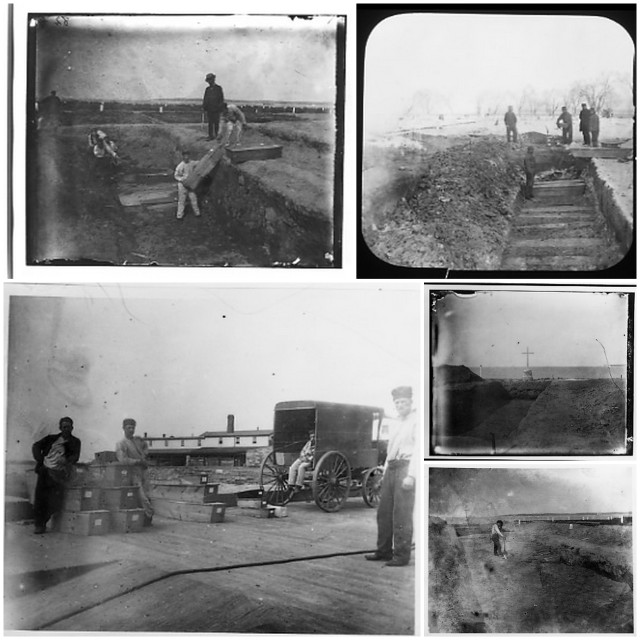
Hart Island is a thin, half-mile long blip of land at the yawning mouth of Long Island Sound, just across the water from City Island in the Bronx. Depending on who you ask, it was named either for its organ-like shape or for the deer (or hart) that thrived here after trekking across the frozen sound in the 18th century. Hart is dense with history; it’s been used as a prison for Confederate soldiers, a workhouse for the poor, a women's asylum, and a Nike missile base during the Cold War.


Its most important role has been to serve as what’s known as a potter’s field, a common gravesite for the city’s unknown dead. Some 900,000 New Yorkers (or adopted New Yorkers) are buried here; hauntingly, the majority are interred by prisoners from Riker’s Island who earn 50 cents an hour digging gravesites and stacking simple wooden boxes in groups of 150 adults and 1,000 infants. These inmates—most of them very young, serving out short sentences—are responsible for building the only memorials on Hart Island: Handmade crosses made of twigs and small offerings of fruit and candy left behind when a grave is finished.


There are a few ways to end up on Hart Island. One third of its inhabitants are infants—some parents couldn’t afford a burial, others didn’t realize what a “city burial” meant when they checked it on the form. Many of the dead here were homeless, while others were simply unclaimed; if your body remains at the city morgue for more than two weeks, you, too, will be sent for burial by a team of prisoners on Hart Island. These practices have given rise to dozens of cases where parents and families aren’t notified in time to claim the body of their loved one. It can take months (even years) to determine whether your missing mom, dad, sibling, or child ended up at Hart.
Even if you do learn that a friend or loved one is buried at Hart, you won’t be able to find out exactly where. Though Hart Island is the largest publicly funded cemetery in the world, it’s been closed to the public since 1976, when the Department of Corrections took control of the site. Family members can request a visit on the last Thursday of every month, but they aren’t allowed to visit specific graves—in fact, there’s no official map (not to mention burial markers) of the mass graves on Hart. The Hart Island Project, a nonprofit organization led by an artist named Melinda Hunt, is spearheading the fight to change that: Hunt has worked for decades to convince the city to transfer control of the island from the DOC to the Parks Department, making it into a public cemetery in name, as well as in function.

 Hunt got involved with Hart during the 1980s, when the AIDS epidemic put the island into the public spotlight for the first time (the first New York child to die of the virus is buried here in the only individual grave on the island). Her book about the island was published in 1998, and represents the last time an artist was allowed to work on-site. Since then, Hunt has single-handedly acted as the sole legal and political advocate for families of the deceased buried here, and in the process, become the foremost historian and keeper of knowledge about the island.
 
Image copyright Joel Sternfeld and Melinda Hunt. From their 1998 book, Hart Island.
Part of her self-assigned job is to liaise with family members searching for information about their loved ones—like Elaine Joseph, a lifetime New Yorker and veteran who now serves as Secretary of the Hart Island Project. It’s taken Joseph more than 30 years to find out that her child was buried on the island—not an unusual scenario, it turns out, though no less heartbreaking. It’s women like Joseph, who have come forward to tell their stories, who are helping Hunt to raise awareness of the gross mishandling of Hart Island.
On a dreary, lukewarm morning last month, Gizmodo—myself and co-worker Leslie Horn—along with two other reporters, met Hunt and Joseph in the quaint town of City Island. They had graciously offered to include us on a tour of the island, and we were about to become some of the first members of the press to visit since the 1980s.

 Because inmates perform weekly burials on Hart Island, the DOC treats outside visitors with a certain amount of caution. The two polite employees we met on the rundown dock at City Island asked first for our IDs, then for any electronics we had, storing our phones, tablets, and laptops in manila folders inside a DOC trailer on the dock, where we also used the restroom (there are none on the island). Inside the stall, someone had taped up a picture of a manatee—a reference to this meme—with the following mantra: Everything will be OK.


Hart Island photographs by Jacob Riis via The Hart Island Project
 
After everyone was ready, we boarded a small ferry and chugged off into the fog. To overly-dramatic loons like me, stepping aboard felt like crossing the River Styx or sailing out to Arnold Böcklin’s Isle of the Dead—except, in this scenario, the gatekeepers were clad in NYC corrections uniforms. As Joseph recounted her story, and our ferry slogged across the channel, it became clear that, for the loved ones of people buried here, the fight for Hart Island isn’t about entering an underworld—it’s about seeking the right to mend ties with the living.

35 years ago, Joseph gave birth to a baby girl who needed surgery a few days later. The operation took place at Mount Sinai Hospital during the Great Blizzard of 1978, which shut down the city’s roads and phone lines for days. When a recovering Joseph got through to the hospital, she learned that her baby had died during surgery. Eventually, she was connected with the understaffed city morgue—which informed her that her child had already been buried with other infants. When the death certificate finally arrived, no cemetery was listed.

In city parlance, a blank spot next to the cemetery means one thing: A Hart Island burial. But, in a time before the internet, that fact was lost on anyone without inside knowledge—and Joseph spent the next decade trying to find out where her daughter was buried, visiting the Medical Examiner’s office and digging through the municipal archives. It was as if her child had never been born. “It came to a standstill,” she says, speaking over the phone later. “Over the years, I went on with life.” But every so often, she’d try again—fruitlessly searching the city’s archives for a trace.

 It was only in 2008, 31 years after she gave birth, that Joseph’s first lead emerged—thanks to the internet. A Google search for “potter’s field” returned a mention of Hart Island, and then, the Hart Island project—headed up by one Melinda Hunt. She sent her an email. A few months later, after a Freedom of Information request granted them access to burial records, the duo made a heartbreaking discovery: Two volumes of infant burial records, spanning 1977 to 1981, were missing. The lead had gone cold.


Grave of first child to die of AIDS in NYC, with burial documents. Photo by Melinda Hunt via The Hart Island Project
What’s perhaps even more painful about city burials is that the relatives whose loved ones are buried on the island—thousands of the living—can’t freely visit it. Instead, they must request a visit formally from the Department of Corrections, which will usually grant the right to visit a small gazebo near the dock, rather than any of the actual burial sites. Our tour was Joseph’s second time on the island, and she visibly fumed about being forced to sign into a DOC visitor’s book as we disembarked.

 It’s a grim scene: A trash-covered shoreline gives way to scrubby brown grass and a gravel driveway, where two rusting vans are parked beside a handful of officers waiting to check our IDs. The only sign of the island’s purpose are several tiny white angel statues that line the rotting pathway around a nondescript garage building. The cherubs seem like new additions, judging by the tags still visible on their behinds.
The two DOC guides flanked our small group closely on either side, guiding us along the shore. Our “tour” of the island was, in a sense, over even before it began: The final destination is less than 20 yards from the dock, where a small wooden gazebo—someone in the group calls it a “chicken coop”—gives shelter to mourners who visit the island. The DOC’s regulations prevent us from walking further into the patchy grass that covers the island, so we sit down on the benches inside the hut.

A few feet away, a small gravestone represents the only sign of a burial memorial. The stone was paid for by the family of the island’s long-time backhoe operator when he passed away. Behind it, a Victorian-era administrative building, likely left over from the island’s one-time psychiatric hospital, lies in ruins. Any real grave markers that remained were removed years ago by the DOC; today, Hart looks like a dreary but nondescript spit of land you might find anywhere else along the mid-Atlantic.

 
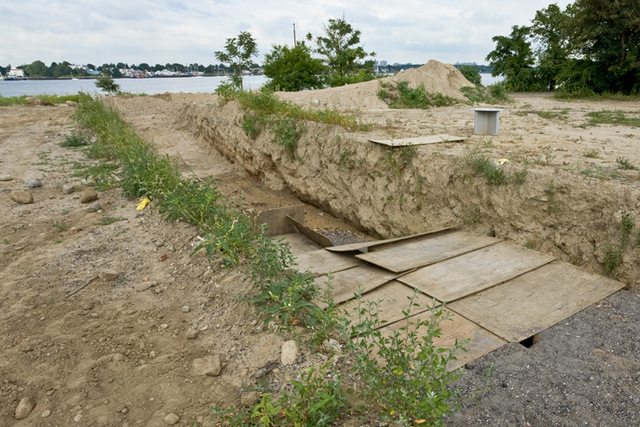
An open burial pit next to the wards in the west of the island. Source: Kingston Lounge

Hunt and Joseph pull out a pen-marked map (pieced together by Hunt using satellite imagery) and try to locate the general direction of where her daughter—along with many other misplaced infants from the same year—might lie. It’s woefully inadequate, not to mention unnecessary given the advent of GPS. Even if the DOC doesn’t create markers for each gravesite, they could certainly make the information available online. But Hart—right down to its decaying Victorian buildings—is stuck in the past. As Hunt explains, much of the way Hart operates dates from the Civil War. “This is a very 19th century kind of place,” she adds.
But it doesn’t have to be. Hunt, who qualifies as nothing short of a hero, is working to extract answers to painful questions—not only at the personal level, but at a legal one. Do loved ones have a legal right to visit a family gravesite? In some states—mostly in the South, where Civil War graves often lie on private land—yes. But, in New York, things are more ambiguous: State public health laws codify the common law right to a decent burial, but it is unclear whether that includes the right to visitation. In 2012, a New York Ob/Gyn named Dr. Laurie Grant, whose stillborn daughter was buried on Hart Island without her consent in 1993, brought a lawsuit in New York State Court seeking an injunction against the DOC that would allow her to visit the gravesite.

 Thanks to years of testimony by Hunt, things are slowly changing on the city side of things: In April, the DOC set up an online database of burial records. And in September, Hunt tweeted that the DOC would grant access to GPS information, too. Just this week, a request to visit grave sites made by Joseph and seven other women received a response that promised their petition is being considered.
After all, the Department of Corrections isn’t to blame, since it’s their job to run prisons—and they do this well—but prison guards simply aren’t a good match for running a massive cemetery. The next big push will be a bill first introduced last year, which would mandate the Department of Parks to assume control of the island. A big part of getting the bill off the ground—and mothers like Grant and Joseph to their children's graves—is rousing public awareness and support. In many cases, New Yorkers just haven't heard about what's going on at Hart.

 What’s most curious about the situation, in some ways, isn’t whether the city will eventually open up Hart Island to the public—that seems all but inevitable—but what will happen to the island afterward. Hunt’s hope, which she described in a New York Times op-ed last month, is that the island will become the city’s next public park and memorial to the city’s past inhabitants. “I like to think of Hart Island as New York City’s family tomb,” she wrote. “We don’t always get along, but we do live and die and are buried close to one another.” Joseph, for her part, would just be happy with grave markers. “I have nothing to lose by continuing to fight for these rights,” she added as we left the island last month. Today, she’s hoping that Bill de Blasio’s election as mayor will speed up the process.

 
One of the mass graves that fit up to 150 adult coffins. Source: Kingston Lounge
The big question, of course, is why? Why hasn’t the city taken over control of the island? Why hasn’t anyone attempted to make it easier for families to visit? Where is the harm or danger in letting people mourn near where their loved ones lie? Tragically, the answer is similar to the reason people end up at Hart Island in the first place: A mixed bag of budgetary issues and pure practicality, wrapped up in a painful and banal truth. In a city of eight million, some things—whether people or whole islands—slip by unnoticed.

Another excellent website about Hart Island can be found here:  http://untappedcities.com/2013/07/22/abandoned-hart-island-new-york-citys-mass-burial-ground/