Showing posts with label Operation Amarillo. Show all posts

Thursday, November 1, 2012

With the Black Scarves at Bong Trang - Part 2


“The First Infantry Division Headquarters named it the Battle of Bong Trang, but those American soldiers who made war there will always call it 25 August.  That is the day in 1966 that my unit fought the Phu Loi Battalion. . .” William J. Mullen III
Captain William Mullen’s Charlie Company of the ½ Infantry was not technically surrounded, although fire was coming from all directions.  But Mullen was not in a defensive frame of mind.  He continued to press the attack in areas of his line and asked his Battalion Commander, Major Richard Clark, to hold off on the reinforcements so that close air support and artillery plaster the enemy.  Major Clark, who could see more of the fight unfolding from a helicopter, declined Mullen’s suggestion and hurried his A Company and B Company to the rescue.  Clark remained in the air where he could see and control the entire fight.  Troop C of the ¼ Cavalry also linked up with B Company for the race to the sound of the guns. 
C Troop of the 1/4 Cav move out on the morning of August 25
From: http://quarterhorsecav.org/pg4g1.htm
Charlie Company had been fighting for almost four hours before Captain Johannsen and B Company found their way through the tangled jungle and into the clearing.  Only the sound of firing and circling helicopters allowed Johannsen to find his way to the beleaguered Mullen.   Heavy automatic weapons fire and mortars pinned them down almost immediately.  Captain Johannsen was wounded by grenade fragments and his intelligence officer, Captain George Downs, took command.  B Company made three unsuccessful attempts to break through to Charlie Company.  Only fourteen men made that last charge.  By then, Captain Downs was wounded and the battalion communications officer, who accompanied B Company, was in command.

Eventually the C Troop of the ¼ Cavalry broke through in their tanks and APCs.  Captain Slattery of the Cavalry found dead and wounded littering the ground and that men had become separated from their platoons and squads.  Hank Stewart of the 1/4 Cav recalled, "2 tracks from C Troop had been knocked out by RPG and 57 recoilless. The crews were all dead. We took up forward positions and our one tank began firing canister into the base camp. We returned fire with .50 cal and M60s. The platoon leaders TC, Sammy Larkin was killed. Lt. Klippen shouted over the radio to "burn the piss out of those treetops".  He was killed right after that."


The 1/2 Infantry Black Scarf worn by PFC John Johnston in Vietnam
An Air Force medivac helicopter had already been shot down in the clearing, blocking the small landing space.  Slattery suggested to Mullen that the wounded be evacuated to a landing zone 400 meters to the east of the clearing.  The Cav’s APC were put into service as ambulances and began shuttling the wounded to the new landing zone.  More medivac helicopters, still landing under sporadic fire, transported them out of the fight to safety. 


Harry Guenterberg rode into the clearing with B Company about noon on August 25.  He was one of only 14 men still standing after his Company made three assaults trying to break into to assist C Company. Harry was also present at the genesis of the black scarf.   He watched Ltc Prillman tear a square of  black cloth from a table in a VC hut to make a sweat rag to go around his neck. That gave the commander the idea for making a scarf for each of his soldiers from a stockpile of captured VC black cotton.   Photo courtesy Harry Guenterberg
 Five hours into the fight and still a cohesive perimeter had not been carved out of the chaos.  The Phu Loi Battalion was tenacious.  The smaller American force was just as determined, but the pressure was too great to consolidate their position.  COL Sydney Berry, the Brigade Commander was impatient.  He ordered Major Clark, the ½ Battalion Commander to take charge on the ground.  Clark and Berry’s UH-1s arrived at the landing zone almost at the same time, and they headed on foot to the clearing together.  As they huddled together to discuss their plans a blast of machine gun fire sent them sprawling.  Berry was unhurt, but Major Clark was dead with a bullet through the skull. 
Although it was a battalion level fight at that time, the Brigade Commander felt he had no other choice but to take command on the ground.  Colonel Berry later recalled that he “ran around like a crazy man getting things moving.”  Because he could no longer see the big picture, he had his Operations Officer who was orbiting in a helicopter, coordinate fire support and move reinforcements to the fight. 

The fight intensified as Berry’s other battalions arrived on the scene and entered the battle.  The 1/26 overwhelmed enemy positions on the east flank; 1/16 Infantry attacked from the west and 2/28 Infantry set up a blocking position to the north of the clearing.  As the 1/26 and the 1/16 made initial gains, Colonel Berry ordered them to shift their axis of attack to link in with Captain Mullen’s ½ Infantry who were still being “chewed to pieces.”  Mullen recalled “Captain Jim Madden, commanding B Company of the 26th, one of the first units to fight its way into our location, received a serious wound almost as soon as he reached us.  He nevertheless broke away from the medics in order to apologize to me for having to leave the fight.”
From: http://quarterhorsecav.org/pg4g1.htm

The 1/16 turned north and immediately encountered a well camouflaged bunker system with interlocking fire.  Viet Cong Heavy machine guns, recoilless rifles, mortars and small arms raked A Company.  Within minutes the commander, Captain Peter Knight, was killed and all of his platoon leaders wounded.  1/16’s attack ground to a halt, but as they reorganized the enemy in their immediate front fled from their positions.

As the 1/16 Infantry’s attack wound down, Ltc Paul Gorman commander of 1/26 Infantry, arrived in the clearing with the last of the American reinforcements.  Berry’s entire brigade was now in contact with the enemy.  As Gorman made a triumphant entry on a M48 tank, Berry climbed aboard to shake his hand.  “A machine gun opened up on us, and we unceremoniously scrambled off the tank, dashed across the clearing, and jumped into a VC trench I was using for my CP,” Berry recalled.  Berry left Gorman in command on the ground and returned to resume control of his brigade. 
Night falls quickly in the jungle.  As darkness enveloped the Americans they hunkered down and allowed artillery and a flare ship to keep the battlefield illuminated throughout the night.  The Phu Loi Battalion made no further coordinated attacks.  They were satisfied to wait for an attack in their underground bunkers and send sporadic harassing fire into the American lines.

The early morning of August 26th found Colonel Berry back on the ground at the clearing.  The enemy was still hunkered down in their bunkers.  He wanted them out of the ground where he could kill them, but did not want to send his battered troops in a frontal assault to root them out.  Too many good men had been lost the day before.  Berry and Ltc Gorman decided to call a napalm strike in the bunker system sandwiched between his 1/16 and 1/26 Infantry battalions.  The eleventh canister struck a tree and sent jellied flames across Gorman’s CP, burning a map from the scrambling commander’s hands.  "My map and radio were literally burned up," Gorman remembered, "and I got singed a bit.  I asked that they keep laying the napalm on, and they did."  Gorman watched helplessly as a later canister fell short, into the American lines.  Two Americans died and fourteen were injured in the flames. 

John Johnston recalled the incident.  "Our Air Force dropped napalm on us because some dumbass threw a red smoke grenade out when we marked our position with smoke.  When they dropped the napalm, the gooks left."  Gorman halted the air attacks.  Despite the horror of the American casualties, the napalm had done what was intended.  The Phu Loi Battalion was retreating and leaving their base camp to the 1st Brigade. 
The 1st Brigade spent the remainder of the day mopping up VC stragglers as they scoured the jungle north and east of the clearing.  Early in the day, nine men from the original lost patrol limped into the landing zone.  They had survived by hiding deep in VC bunkers with the  enemy all around them.

John Johnston lived through the twenty four hours of hell that was August 25.  Like many of the men who survived this fight, it is still burned into his psyche.  John later became the "RTO" and carried the platoon sergeant's radio.  He performed the same service for his platoon leader before he was offered a job in the Brigade mail room for his last month in country.  He turned it down ". . .because I was too proud to quit.  I told them about another guy who needed it worse than I did."  John received a Bronze Star for valor for his actions on August 25th.  His citation reads in part: 

Private First Class Johnston noticed a claymore mine set up in the path of his advancing comrades.  Realizing the imminent danger, he courageously rushed forward into a heavy barrage of mortar and automatic weapons fire and deftly disarmed the mine.  Later in the same afternoon, PFC Johnston personally led several members of his platoon in a grenade assault of Viet Cong occupied trenches and bunkers.  They were successful in routing the enemy.

John told me many years ago that "deftly disarmed the mine" meant that he laid the electrical wire across the butt of his M16 and hacked it with his bayonet!  It worked. 
18 year old PFC John Johnston (left) wears his newly won Bronze star with other veterans of Bong Trang. 
Photo Courtesy of the John Johnston
 Johnston was one of many men who were decorated for actions at Bong Trang.  Captain William Mullen and Ltc Paul Gorman were awarded the Distinguished Service Cross.  Mullen, Gorman, and Berry all became general officers later in their careers.

Captain William J. Mullen III receives his Distinguished Service Cross from General William Westmoreland
during a ceremony after the battle of Bong Trang.  Probably one of the few times were a 1/2 Infantry
 black scarf was cleaned and pressed!  Photo from:  http://www.legionofvalor.com/citation_parse.php?uid=994197960
All battles come with a human cost.  For Vietnam War standards, August 25 was a murderous day.  The 1st Brigade of the First Infantry Division lost 43 killed and 248 wounded.  C and B Company of 1/2 Infantry sustained the lion's share of these losses.  Captured documents later revealed that the Phu Loi Battalion lost 171 killed at Bong Trang and their wounded filled VC medical facilities in the region.
AUTHORS NOTE:  I have one other connection to this story.  When I served with the First Infantry Division in the early 1980s, Colonel William J. Mullen III was my Brigade Commander.  Colonel Mullen was well liked and respected by his officers.  His part as a young captain in this battle so many years before, and the fact that he was a recipient of the Distinguished Service Cross (second only to the Medal of Honor in precedence) was unknown to us.  He was a level headed and humble commander, who expected the best from his men.

Wednesday, October 24, 2012

With the Black Scarves at the Battle of Bong Trang


1st of the 2nd, The Black Scarf Battalion


In April 1966, Sgt. Harry Guenterberg watched Ltc Richard Prillaman tear a square of black cloth from a table in a VC hut to make a sweat rag to go around his neck. That gave the commander an idea.  American soldiers working in the tropic climate of South Vietnam often wore green towels or cloths around their neck to keep the flowing sweat under control.  Although the practice was “non-uniform” it was tolerated by leaders.  The village of Lo Go, that Prillaman and his troops had just captured, harbored a large stash of black cotton cloth, destine to be fabricated into black pajama Viet Cong uniforms.   Ltc Prillaman, commander of the 1st Battalion, 2nd Infantry Regiment, took the cloth and had it made into something useful, but distinctive.  The whole battalion would soon sport uniform black neck scarves. 
 
Someone suggested distinctive company embroidery and developed a color scheme to go with it: HHC - yellow, Company A - red, Company B - white, Company C - blue and Company D - green.  So was born the Black Scarf Battalion.  The battalion continued this tradition until they re-deployed to the United States in 1970.   (From "2nd Infantry Regiment" by Larry Grzywinski, http://www.secinfreg.org/2nd%20Infantry%20Regiment%20for%20the%20web%20site(01162015).pdf)


LTC Richard Prillaman.  Prillaman went on to command an Armor Division during the 1980s.
He retired as a  LT General.  Photo courtesy Stanley Richards.


1/2 Infantry, Black Scarf soldiers clean thier equipment after an operation. 
Photo courtesy John Johnston

 A Treasure Re-Found

Thirty one years ago I was new 2nd lieutenant getting ready to ship out to the First Infantry Division.  The "Big Red One" had a storied history from WWI, WWII and Vietnam.  I was very proud to have been assigned to that famous division. 

 Greg McMahon and Curtis Quickle, my best home town buddies, took me out for a last fling in Little Rock before I departed for Fort Riley, Kansas.  At one of our stops, I ran into a gentleman who sported a First Infantry Division pin on his cowboy hat.  Next to the division pin was a unit crest for the 1/2 Infantry  -  the battalion in the First Division where I was to be assigned! 

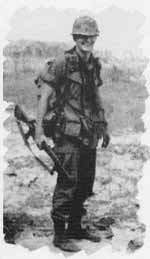
 I hailed him of course, and we struck up a great conversation.  John Johnston had seen combat with the 1/2 Infantry in Vietnam.  I got his address and we corresponded for several months after that.  I felt truly humble, and privileged when he gave to me the Black Scarf that he wore in Vietnam and photos of himself taken in country.

 I treasured those artifacts, but during one of my many military moves they were lost - or so I though.  I   mourned the loss of those items for many years, until they recently resurfaced when I found them tucked away in a long forgotten box. 

 This is the story of John Johnston and the Black Scarf Battalion at the Battle of Bong Trang, one of the fiercest battles of the Vietnam War.
"C Company weren't culls on 25 August, 1966.  C Company and B Company were wiped out that day."

At the peak of the Vietnam monsoon season, the 1st Brigade of the 1st Infantry Division began a routine road clearing operation.  Operation Amarillo, as it was called, was intended to remove mines and IEDs along several roads in Binh Long and Binh Duong Provinces.  Most of the clearing would occur along Highway 16 between Phuoc Vinh, the brigade base camp, south to Di An, the division headquarters.  The first two days were uneventful.  On the night of August 24th, Capt William Mullen sent out a fifteen man patrol from C Company, 1/2 Infantry.  They were to stay over overnight and listen for potential movement of enemy forces.

The next day dawned clear, a respite from the monsoons.  The patrol soon walked into the middle of a North Vietnamese base camp, that until that time had remained undetected.  As the patrol realized their mistake, they sent out an urgent call for help.  Within minutes half were dead and the survivors were fighting from abandoned NVA bunkers.  Five hundred men of the Phu Loi Battalion of the NVA army were swarming to the attack.  Only artillery fire called in on their own position by the patrol kept the enemy at bay.

Pvt. John Johnston of Little Rock, Arkansas was a baby faced 18 year old rifleman in C Company.  He, along with the remainder of C Company and a platoon of the 1st Squadron, 4th Cavalry Regiment (1/4 Cav) loaded on one M48 tank and seven M113 armored personal carriers and sped to the rescue.  As the relief force neared a large clearing in the NVA camp, the enemey ambushed C Company. 

Photo courtesy of John Johnston
Lt James Holland, on his first combat operation as a platoon leader remembered, "When we were about 400 meters from them all hell broke loose. We deployed off the cav vehicles and we all returned fire. Our fire suppressed the VC and my company commander told me to take an A Cav and a tank, mount my platoon and go get the squad. We pulled out of the perimeter and headed for our objective. When we were about 400 hundred yards out the company and the vehicles we left were hit hard. I was ordered to return. As we turned the tank threw a track. Because it would have taken to long under those conditions to repair it we had to leave it. After destroying it we headed back in to the fight."  Lt Holland was wounded and three of his vehicle commanders were killed immediately as mortar and heavy machine gun fire tore through the column.  Casualties mounted as C Company engaged the Phu Loi Battalion. 
Lt James Holland. From:
http://www.leonflpurpleheart.org/Patriot.Holland.htm 
As the leader of Troop C's 2d Platoon, Sgt. Wilbur J. Barrow, reported, "Every time we tried to get out, we were hit by mortars and hand grenades." As the commanders fell, Barrow continued, "privates were taking command of the tracks and calling  me to ask for help. My answer to them was to pick up their wounded and take salt pills and drink water, and pray, pray, pray! There was no help for anyone.”


"We were in their base camp and they wanted in and we didn't let them."

 The fight turned into a close quarters slug fest.  Only artillery support saved Mullen's force from being overrun.  Mullen remembered later: "Until 2nd Lt Bruce Robertson, our forward observer was evacuated, he called for artillery fires on a continual bases, despite blood spurting from numerous wounds."

 Casualties continued to mount, and no one knew how long it would take for help to arrive.  Mullen recalled: "While talking on the radio, I heard someone say, 'Charlie Six.' I looked up to see Specialist Tommy Freese, the only man in his platoon who was not a casualty.  As bullets few all around, Tommy stood in the open with a 60mm mortar on one shoulder and a sack of ammunition on the other. 'Sir' he said.  'The fourth platoon is ready.  Where do you want me to shoot?' "

From: Combat Operation: Stemming the Tide - May 1965 - October 1966. 
John M. Carland, Office of the Chief of Military History, Govt Printing Office
Pvt John Johnston paints a vivid picture of the fight. "It was a bad day that burned in my mind.  24 hrs of fear despair and anger.  We shifted around all day, trench to trench.  I used lots of grenades.  There was a continuous roar.  Gunpowder and the smell of soured blood.   Powder burns on my arms from buddies weapons.   Hot rifle shells going down my collar.  Hot.  I don't know how we survived."

 Now C Company and the cavalry needed to be rescued.  The remainder of 1/2 Infantry was committed immediately and raced to the fight.  Soon, the Brigade commander had all of his battalions moving to the NVA base camp.  1/16 Infantry, 1/26 Infantry, 2/28 Infantry and the remainder of 1/4 Cavalry were moving to the sound of the guns in a hasty attack.

 Help was coming, but could Charlie Company hold out? 

Next time:  Part two http://erasgone.blogspot.com/2012/11/with-black-scarves-at-bong-trang-part-2.html