July 4th was the darkest day of the
Confederacy. Four simultaneous military
events, scattered over 900 miles, sealed the ultimate fate of the "Lost
Cause." Even though another year
and a half of bloodshed would follow, the South could not win after the events
of the that Independence Day.
Most Americans have heard of the Battle of
Gettysburg and the Siege of Vicksburg. The
defeat of the Confederate Army of Northern Virginia in Pennsylvania and the
Capture of the full length of the Mighty Mississippi River at Vicksburg were irreversible
catastrophes for the South. More
advanced students of the Civil War will also know of the Tullahoma Campaign in
Tennessee. There, Union General William
Rosecran's Army of the Cumberland skillfully forced Confederate General Braxton
Bragg's Army of Tennessee out of Tennessee in a brilliant campaign of flanking
and maneuver. The last of Bragg's men
trudged into north Georgia on the same day that Lee's army was attacking on Cemetery
Ridge at Gettysburg in what would later be called Picket's Charge. (You can
learn more about the Tullahoma Campaign here: http://en.wikipedia.org/wiki/Tullahoma_Campaign
)
On July 4th Lee began his retreat out of
Pennsylvania back to Virginia, Vicksburg surrendered to Union forces under
Ulysses Grant and Braxton Bragg stumbled out of Tennessee, never again able to
hold ground in that vital state. On one
fateful day, the fortunes of war had turned against the South. It could never regain the initiative.
But there is a fourth element to this dark day that
is overlooked by all but the most devoted students of the War. Had it occurred at a different time it might
be better known, but it has been obscured by momentous events further east.
On July 4th 1863, the Confederate Army of the
Trans-Mississippi commanded by Lt. General Theophilus Holmes launched its full
weight against the Union garrison at the Mississippi River town of Helena,
Arkansas. The attack was intended to
draw pressure off the besieged town of Vicksburg and to capture another position
where the mighty river could be defended.
The attack was a failure from the start.
The Army of the Trans-Mississippi was bludgeoned into a stupor. The Confederate Army west of the Mississippi
River would never again go on an offensive footing. Within two months, with Helena as a jumping
off point, the Union Army launched a campaign that captured the state capital,
at Little Rock.
I'll not try to write a new description of the Fourth
of July events at Helena. Instead I'll offer
this excellent synopsis of the battle by historian Alethea Sayers.
Helena: The
Forgotten Battle
by:
Alethea D. Sayers
The port city of Helena, Arkansas is seventy miles downriver from Memphis,
and two-hundred and thirty miles above Vicksburg, where the base of Crowley's
Ridge meets the Mississippi River. Union troops under Maj. Gen. Samuel Curtis
had occupied Helena in July of 1862, allowing the Federals to control trade
along the river. For the Confederacy, the Federal garrison also posed a
constant threat of invasion into the rest of Arkansas. By July of 1863, there
existed another important factor that led the Confederate high command to
support an attack on the enemy at Helena. Secretary of War, James A. Seddon,
believed an attack on the Federal base, now commanded by Maj. Gen. Benjamin
Mayberry Prentiss, might draw away troops from Vicksburg, thereby alleviating
pressures on Pemberton. If the attack was successful, the Confederates position
on the Mississippi might compensate for a possible loss of Vicksburg.
 |
| Maj. Gen. Benjamin Mayberry Prentiss |
It was to discuss the feasibility of an attack that Lt. Gen. Theophilus
Holmes, commanding the District of Arkansas, met with his subordinate, General
Sterling Price. General Price, affectionately known as "Old Pap," was
very popular among his troops, and also very eager to show his confidence in
his men's abilities. Though initially convinced such an attack might prove very
costly, Holmes was persuaded that the Union garrison at Helena had been left
very weak, as all available troops had been diverted to Vicksburg. Despite his
reports indicating there were 4,000-5,000 troops still in possession of Helena,
Price, along with the urgings of Marmaduke and Kirby Smith, were able to
convince Holmes the Confederates would be victorious in an assault on the town.
 |
Lt. Gen. Theophilus Holmes.
Called "Granny Holmes" by his troops
|
The recent departure of thousands of Union troops to Vicksburg, left Helena
with only 4,000 effective men. These men were commanded by the
forty-four-year-old General Prentiss, the same Prentiss who had earned his
reputation at the "Hornets Nest" in the battle of Shiloh. Prentiss
was promoted to major general in March of 1863 and given command of the
District of Eastern Arkansas, headquartered at Helena. When word reached
Prentiss of a possible attack on Helena, Prentiss made certain the town was well
fortified and his men were at their posts every morning by 2:30 a.m..
To protect the garrison against Confederate attack, Prentiss placed four
batteries (A,B,C & D), surrounded by breastworks and rifle pits, on four
hills that formed a semi-circle around the town. Additionally, firepower was
added by the U.S.S. Tyler, a steamer anchored off the river bank. Prentiss's
principal defense was provided by Fort Curtis, located on the western edge of
town.
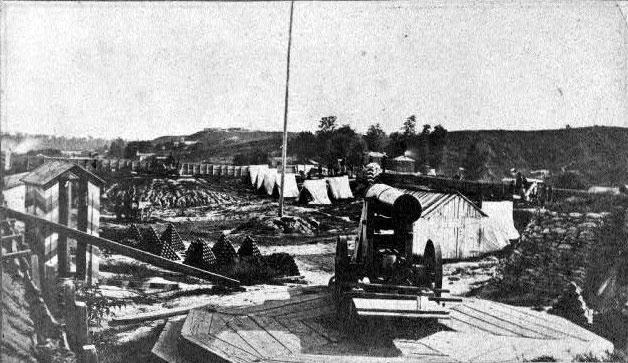
 |
| War time photograph at Fort Curtis, Helena Arkansas |
When Holmes arrived at the Allen Polk house, five miles from Helena, on July
3, he assumed overall command of the converging forces; Price's infantry and
Marmaduke's cavalry from Jacksonport, and Brig. Gen. James Fagan's command from
Little Rock. Holmes' combined strength would be 7,646. Of the aging Holmes' arrival,
one soldier would note; "General Holmes and his staff are here. Poor old
creature. I wish he was somewhere else, for I do not think him a fit subject to
command an army." Though Holmes was undoubtedly anxious when he found
Helena so strongly fortified and the terrain difficult to contend with, he was
determined the trip should not be made for nothing.
The Confederate plan of attack would consist of a three-pronged effort.
Marmaduke's 1,750 dismounted cavalry were to attack Rightor Hill on the northwest
(where Union Battery A was located). His attack was to be supported on his left
by the cavalry brigade commanded by Brig. Gen. L. M. Walker. Walker was to
prevent Federal reinforcements to Rightor Hill. Fagen's 1,339 men were to move
against Hindman Hill, located southwest of the town and where Union Battery D
had been placed. The center thrust would be made by Price's infantry of 3,095
men against Graveyard Hill, which was also near the center of the Union
defensive line and Battery C. The Confederate attack was to begin "at
daylight" on July 4.
 |
| Brig. General John S. Marmaduke |
The Confederate attack began with Marmaduke's dismounted cavalry attempting
to advance toward Rightor Hill. His men immediately came under an infilading
fire from Federal troops along a levee to his left and rear. Walker, who was to
have protected Marmaduke's left flank was concerned with his own left flank and
refused to come to Marmaduke's assistance. *The hostility that developed
between these two men over this battle would later result in a deadly duel between
them.
Farther to the right, where Fagan was to assault Hindman Hill, a
miscommunication between Fagan and Price caused Fagan to come under the
withering fire of Federals on Graveyard Hill. Fagan had assumed that
"daylight" meant attacking at first light, while Price interpreted it
at sunrise. Price's attack did not get underway until an hour after Fagan
assaulted Hindman Hill. Though Fagan managed to overrun the rifle pits, he
suddenly found himself pinned down by artillery fire from batteries C and D.
Finally, Price began his attack on Graveyard Hill. The Confederates were
repulsed twice, with heavy casualties, before their determined assault was
successful. They were the only force to reach their objective. Prentiss would
comment on their determination exhibited as; "...a courage and desperation
rarely equaled." Price's men attempted to turn the captured battery on the
retreating Federals, but found the guns had been disabled.
 |
| Brig. Gen. James Fagan' |
With the arrival of Holmes on Graveyard Hill, the situation for the Rebels
was made worse by a series of confusing orders. Some of Price's men moved to
attack Fort Curtis, while others attempted to go to the aid of Fagen's pinned
down troops. Suffering from exhaustion and the July heat, their efforts proved
futile and Fagen was forced to retreat back through the rifle pits he had
captured. By 10:30 a.m., Holmes realized the situation was hopeless and ordered
a full retreat, his rear guard skirmishing until 2 p.m..
The battle was a great victory for Prentiss, whose fortifications had held
off a numerically superior foe. His losses were light in comparison, suffering
57 killed, 146 wounded and 36 missing for a total of 239 casualties. The U.S.S.
Tyler had proved devastating to the attackers, firing 413 rounds.
 |
| War time photo of the USS Tyler. |
The aftermath of the Confederates desperate assault on Graveyard Hill was
ghastly, where the bodies of the dead lay piled in heaps on the hillside,
causing one Wisconsin soldier to write; " I never want to spend another
such a "Fourth of July." Out of the 7,646 Confederates involved, 173
were killed, 687 wounded and 776 missing for a total of 1,636 casualties. The
Battle of Helena proved costly and demoralizing for the Arkansas Confederates.
Battered and defeated, the news of Gettysburg and the loss of Vicksburg was
more than enough to douse the flame of hope for the Southern soldiers. The
winds of war had changed, yet it would go on for another bloody year and a
half.
Excerpt of a letter home, written by Henry S. Carroll, Orderly Sergeant,
Co. D, 33rd Missouri Volunteer Infantry:
"Dear Mother,
I take pen in hand this morning in haste to inform you that I am in
excellent health. You will probably have heard before this reaches you that we
have a fight here. And most a bloody one it was too. Yesterday morning we were
attacked at half past four o'clock by the rebels under Price, Marmaduke and
Holmes. We were expecting an attack and as I mentioned to Edna the other day in
my letter we were ordered into line every morning before daylight. Yesterday
morning I was up at two o'clock and was engaged in delivering some tools to be
used in the rifle pits. I remained up the balance of the night. At half past
three the Capt ordered me to get the company into line.
Everything was calm and serene and we began to think the rebs had concluded
not to attack us. I divided the men into gun squads and scarcely had the men
taken their posts ere an officer rode up and ordered us to fire an alarm gun
which we did. In ten minutes afterward, the enemy attacked our batteries on the
left, almost as the fight opened on the right and center. I think the rebels
had their whole force engaged. Our center was headed by two companies of our
regiment who were protected by some earthworks in which were planted two brass
field pieces. A rebel brigade charged upon this work. They were composed of the
7th, 8th,and 12th Missouri rebel regiments. The ground over which they charged
was very broken and the two guns and the infantry in the rifle pits made
fearful havoc among them.
The fight by this time was raging fearfully all around the lines. All this
time we were standing at our guns. I commanded gun No.6 in Fort Curtis. We
loaded first with a shell. The fog was so thick that at the distance of six or
seven hundred yards,we could not distinguish our men from the rebels. This was
just at sunrise. Gradually as the sun arose, the fog lifted and cleared away
and I could see them coming in to flank the battery on the hill opposite us. I
asked the Capt if I could give them a fourth of July salute. He replied to give
it to them and thus opened the most murderous fire from our guns that ever men
withstood.
But nothing seemed to daunt the foolhardiness of the rebels; they came on
yelling like indians all the time. Our men at the batteries were overpowered
and compelled to retreat. They retreated to Fort Curtis. The rebs rushed to the
top of the hill and formed a new line. They seemed to think they had gained the
day but they were woefully mistaken. While they were forming,we were throwing
shot and shell into them that told fearfully. Their colors were posted in a
very conspicuous place and time after time they dropped to the ground. Men
would rush up and hoist them again but only to be shot down.
As soon as they were formed, they began to advance toward us. They had to
cross seven hundred yards of open ground. They seemed as they intended to take
us at the bayonet point. They advanced steadily and briskly while six heavy
guns from one fort and also several companies of infantry, that had been driven
in from the outer works, were mowing them down under this murderous fire. They
advanced four hundred yards.
They were so close,the day seemed lost in spite of all we could do. At this
distance, we poured in a double charge of grape that made them reel and
stagger. Their officers waved their swords and tried to urge the men forward,
but it was of no use. It was not human to stand it. They broke and began to
retreat and such a slaughter was never greater on any battlefield west of the
Mississippi. They started up the road and I trained my gun upon it, as also did
two other gunners in the fort. We all fired at once and when the the smoke
cleared away not a man was to be seen within a rod of the place. Dead,
dying,and wounded were strewed thickly on the ground. This charge was made down
a hill and so perilous was it to retreat that they fell closer to us in a
hollow, and the way we did slaughter them was something.
They soon raised a white flag and all of the eighth and tenth Mo rebels
regiments surrendered but what lay on the field dead and wounded. We captured
one thousand prisoners, two cols., 7 captains, 14 Lts., and guns and accouterments
by the card.
I could not give you all the minute details if I were to write two days but
will do so in a few days. By eleven o'clock they had retreated and the firing
had ceased. And such a looking set of fellows as we were all black with powder
as negroes and well we might be for we had fired 103 rounds from our gun during
that time. Every one of our company behaved nobly; we are all heroes. Old Pike
(County) may well be proud of her representatives here yesterday.
Our Colonel,who was at Pittsburg Landing and Corinth and many other battles
of this war says the 33rd are every one heroes. General Salomon says he never
saw artillery used more effectively than we did ours yesterday. Not one of us
was hurt though the fort is sickening full of balls. The gun carriages
(damaged?) but no one was hurt inside the fort. But the enemy were slaughtered.
It was supposed yesterday evening that there were two hundred of their dead
on the field, but our men have been burying them since three o'clock yesterday.
We find them behind logs and stumps and in hollows. Everyone seems to think
that there are at least four hundred of their dead on the field. I have just
been over the battlefield and no language can describe its horrors. It was a
scene I never shall forget. Men were torn and mutilated in every possible
manner. They were all Missourians. Numbers of them surrendered that could
easily have escaped. There happened to be a steamboat here at the time and we
put six hundred on board of her and started them to Memphis in one hour after
the surrender. I suppose you will see an account of it in the papers before I
write again. I must close as the mail is ready."