Showing posts with label War in the Pacific. Show all posts

Tuesday, September 13, 2016

16 Days To Die – Three Sailors trapped in the USS West Virginia


USS Arizona is the best known of the battleships sunk during the Pearl Harbor attack.  And rightly so because of the massive loss of life on that famous ship.  The USS Utah also still lay on the bottom of Pearl Harbor, its rusted hull is still visible on the south shore of Ford Island.  Less is written about the USS Oklahoma and the USS West Virginia.  Both were raised and repaired and saw service later in the war.  This story is about the West Virginia and the men who survived the attack but were trapped below decks.


Re-blogged from War History Online.  https://www.warhistoryonline.com/featured/pearl-harbor-16-days-to-die.html

The USS West Virginia as she appeared in 1934.
She still had this basic configuration during the attack on Pearl Harbor


In the aftermath of the attacks on Pearl Harbour during World War Two stories emerged of sailors who were trapped in the sunken battleships, some even survived for weeks.

Those who were trapped underwater banged continuously on the side of the ship so that anyone would hear them and come to their rescue. When the noises were first heard many thought it was just loose wreckage or part of the clean-up operation for the destroyed harbour.

The USS West Virginia the day after the attack


However the day after the attack, crewmen realised that there was an eerie banging noise coming from the foward hull of the USS West Virginia, which had sunk in the harbour.

It didn’t take long for the crew and Marines based at the harbour to realise that there was nothing they could do. They could not get to these trapped sailors in time. Months later rescue and salvage men who raised the USS West Virginia found the bodies of three men who had found an airlock in a storeroom but had eventually run out of air.

They were Ronald Endicott, 18, Clifford Olds, 20, and Louis Costin, 21. Within the storeroom was a calendar and they had crossed off every day that they had been alive – 16 days had been crossed off using a red pencil. The men would have been below deck when the attack happened, so it is unlikely that they knew what was happening.

Those who survived the attack and were crew on the USS West Virginia have remembered the story and retold it quietly as a story of bravery and determination of the young soldiers.

In truth, the US Navy had never told their families how long the three men had survived for, instead telling them that they had been killed in the attack on the harbour. Their brothers and sisters eventually discovered the truth but were so saddened that they did not speak of it.

One of Clifford’s friends and comrades Jack Miller often returned to the harbour and would pray for his friend at the site of the sunken wreck. He says that just the night before the attack they had been drinking beer together, and he had wanted to rescue him desperately in the days after the attack.

However there was no way of any rescue crews getting to them since if they cut a hole in the ship, it would flood it, and if they tried to use a blowtorch it could explode since there was too much oil and gasoline in the water.

Survivors say that no one wanted to go on guard duty anywhere near the USS West Virginia since they would hear the banging of trapped survivors all night long, but with nothing that could be done.

The USS West Virginia as she appeared in 1944 after repair and extensive up grading.

You can read more about the West Virginia's career at this link:

https://en.wikipedia.org/wiki/USS_West_Virginia_(BB-48)


Sunday, March 10, 2013

History That Tugs at the Heart


Not all history is about impersonal tales from the distant past.  Some stories, even those from several generations ago, can have an closeness and intimacy that can stir emotion.

Christmas Card sent home by Carlton Church, his last correspondence before
capture by the Japanese in December 1941.


I started writing about Wake Island almost 15 years ago. First in magazines and later in my blog. I get correspondence off-an-on from family members of men who served at Wake Island or were murdered by the Japanese there in 1943. They used to come by US mail, but they increasingly come by email, especially since I launched my blog last year.  When I did the first article on the massacre of 98 Americans on Wake Island by the Japanese in 1943, I mentioned in the article that I wondered if there were still sons or daughter or brothers or sisters who still remembered and thought about these men.  I have learned that after that after seventy years have passed, there are indeed many family members who still mourn the lost.  I suspect the dead of WWII, from all over the world, still have family who think of them. 

Some, like my new friend Gary Binge, tracked me down and phoned me.  The story of Gary's grandfather, and the helmet he brought home from the War, generated the article you can find linked below, and much of the new correspondence that I have received.


Some letters seek information, that sadly I usually cannot provide.  Some write to give me more information, which is very much appreciated.  Some just write to thank me and let me know that families of the "Murdered 98" have found my articles and appreciate them.  I was surprised by how many loved ones did not know the details of their loved one's death, until they found my articles.  Those are the most precious to me.  Here are parts of emails I've received over the last few months.  I've removed full names and hometowns so I would not violate the privacy of these fine folks.  These letters are humbling and gratifying at the same time.  It makes all the research and writing worthwhile. 


Dear Major Hubbs,

I'm writing to thank you for helping solve a long standing family mystery. My wife is the great-niece of Charles M Villines, one of the Wake 98. For all of her life, the ultimate fate of Charles had been unknown to her family. The family had known that he was on Wake island, and had assumed that he had been taken to China, although no record was ever found of it. Charles had married and had had a child before he went to Wake, but his wife had divorced and he and the rest of my wife's family lost contact with her before the war started. We assume that the notification sent in 1946 to the families went to her, although she may well have not received it, having moved in the interim. We do know that his mother, Zula Villines never received any notification and never knew what had happened to her son.

 Although Charles is listed as being from Salt Lake City, he was an Oklahoma farm boy, born and raised in Pottawatomie County. He had moved to Utah looking for work. Charles had two brothers, James and Tony. They both fought in the Pacific Theater and survived the war. Tony died in an oil-field accident in the 1950s. James is still alive, though in very ill health. James has one daughter (my wife's mother) three granddaughters (including my wife), and five great-grandchildren. For my wife and her sisters that unknown fate of their lost great uncle was a wound that was passed on from generation to generation.

 Today my wife was telling our daughters about her lost uncle and our elder daughter, became curious and started searching the Internet and found your account at yorktownsailor.com. I had done an Internet search years ago and found nothing. Knowing what happened to Charles, as horrible as the fate was, has brought a great deal of relief to my wife and her sisters.

 Thank you,

David S.


 (Author's note: This letter from Bonnie C. was especially poignant, and includes a poetic tribute to one of her WWII veteran uncles.)

Dear Friend

 Jack Fenex who was in the mass murder is my uncle. I wept when I read your account that my daughter found. We had many answers, but we had some doubts. My uncle, Elmer Christler was also there, but he became a prisoner of war for four years and came home. My Dad, Walter Christler, wanted to go, but he was turned down because of a bad knee (thank goodness). He served in the Army in the states and left just after I was born.

 I was a baby when the war ended, but the war stories have greatly impacted my life. My uncle Melvin Christler flew "The Hump." My uncle Bill Fenex, walked it. As a child, I remember my mother reading Uncle Jack's letter and crying.

 I know that the stories of sacrifice and service that I grew up with helped me face my trials. It was in my blood.

I was a fussy baby and my Grandpa Fenex rocked me as he listened for war reports. He wasn't sure if Jack had been beheaded because he heard there was a Jack that broke into the kitchen for food as well as the massacre. You simply can't judge.

 My uncle Bill Fenex passed away a short while ago. I wrote this tribute to him:

Good-bye, Uncle Bill

Uncle Bill fought for his country
As an "Honor and duty" with pride.
It scarred his mortal life for sure
In ways that he could never hide.
He held his head so very high
And conquered demons one by one.
May he find the peace he gave to us
With loved ones, the Lord, and blessings won.

 I have sent your article on to many family members and I told them to send them on their families. Again, thank you with all my heart.

 Sincerely, Bonnie C.


Maj Hubbs;

I just came across your article written about the POW Rock on Wake Island, and in it you mention that you travel there from time to time, I have a favor to ask.  If you should travel to Wake Island again, would it be possible to get a small amount of the coral sand from the area around the POW Rock?

Carlton Church's signature is partially obscured by a very fragile chin strap on Glen Binge's helmet.
 

 Please allow me to explain, though I never knew him, Carlton G (Graves) Church was my Great-Uncle, my Grandfather's brother on my mother's side of the family, and one of the 98 civilians murdered on Wake Island.  Ever since I took a simple picture of the memorial at the National Memorial Cemetery of the Pacific back in the 70's, I have been researching Uncle Carl and Wake Island.

 Just this past Tuesday, while going through old boxes of photos etc, I found a small metal lockbox that belonged to my Great Grandmother (Carl's mother), and in it I found a Christmas Card from Uncle Carl, bearing the return address of Wake Island, and written on the edge of the envelope is "last letter received"...it is postmarked San Francisco Dec 27, 1941.

 If you are interested, I can send you pictures of the cards, envelope and letter.

Thank you,

Philip M.

Carlton Church's last note home before his capture by the Japanese. 
Carlton was one of the 98 Americans executed by the Japanese in October, 1943.

 
Mark,


I want to thank you for the Blog you’ve established for relatives of Wake Island Americans who were attacked in 1941. My grandfather worked for the Morrison-Knudsen Co. as a dredge operator. I’ve read several books about the battle for Wake, but unfortunately, the military authors did not include much about the civilians who also bravely fought and suffered.

 Barbara M.


 Hello Mark.  

 My name is Ron.   Uncle, Redmond James (Jim) Wilper was one of the “forgotten 98” on Wake Island.  I have seen photographs of the Binge helmet and I see that my Uncle Jim signed it because you have listed the names of all who signed.  I would like to see a photo of the signature.  Do you have photos of every single signature?  If so, could you possibly send me a photo of Redmond (Jim) Wilper’s signature?  Perhaps you know how I could get in touch with the Binge family or pass my inquiry on to them.  I appreciate your help and I really enjoyed your blog.  Ron

 (Author's note:  I provided a close up of photo of Jim Wilper's signature as soon as I found this email.  The owner of the helmet, Gary Binge, was more than delighted for me to pass on the photo to Jim's family.  I received this reply)
 
Redmond (Jim) Wilper's signature on Glen Binge's helmet. 
Jim was barely out of his teens when he was murdered by the Japanese.
 
Mark: Thank you so much. It came through just great. Jim's little brother Frank, age 88 will greatly appreciate this as will my siblings and our children. It is very thoughtful of you Mark, and you Gary for sending this to us. The saga of Wake Island is still well remembered here in Boise. Best wishes. Ron


Thursday, October 11, 2012

The Hating has to Stop - The "Railway Man" dead at age 93


'Some time the hating has to stop': A tortured war hero, his Japanese tormentor, and the redeeming power of forgiveness.

Re-blogged.  See the complete story here: http://www.dailymail.co.uk/news/article-2215357/Eric-Lomax-A-tortured-war-hero-Japanese-tormentor-redeeming-power-forgiveness.html

Beaten to a pile of broken bones, caged, starved and tortured, Eric Lomax was convinced he would never see Britain ever again.

He had already experienced the lottery of death among the chain gangs on the Burma-Siam Railway. Now things were even worse. Accused of being a spy, he had been left to the mercies of the Japanese army’s secret police.  Among their specialities was what is today known as ‘waterboarding’, when a prisoner undergoes near-drowning. It was surely only a matter of time before he would be put out of his misery.

As his interrogator had explained to him on arrival at the prison camp in 1943: ‘Lomax, you will be killed shortly whatever happens. But it will be to your advantage in the time remaining to tell the whole truth. You know now how we can deal with people when we wish to be unpleasant.’

Eric Lomax was put to work building a railway by his Japanese captors during the Second World War, before he was accused of being a spy and interrogated by Nagase Takashi (below)


And yet Eric Lomax would somehow survive an ordeal so unspeakable that when he was later transferred to Singapore’s notorious Changi prison, he described it as ‘heaven’.

After the war, like so many of those who had survived the atrocities of Japanese captivity, he could barely discuss his experiences with anyone.

He bottled it all up, although he found that tiny things –particularly inaccurate bills or bureaucratic requests for personal information – could almost paralyse him with fury.


 Through it all, he retained a loathing for the Japanese, particularly the infernal interrogator still haunting his dreams with the same words: ‘Lomax, you will tell us...’  Yet nearly 50 years on, Eric Lomax did something extraordinary. He not only tracked down the man – he met him, befriended him and forgave him. And in 1995, he published a powerful account of his experiences.

Called The Railway Man, it swiftly became a bestseller and won a cluster of literary awards. Indeed, so remarkable is the memoir that it is about to come to the big screen – with Mr Lomax played by Oscar winner Colin Firth, no less –and with Nicole Kidman as his wife.

Sadly, Mr Lomax will not see the film. In the early hours of last Monday morning, he died at his home in Berwick-on-Tweed at the age of 93. He leaves a widow and daughter.


Eric's wife Patti (left) encouraged her husband to get in touch with his erstwhile torturer

 But he also leaves an enduring story of the healing power of forgiveness that will be retold long after we are all gone.
 

Monday, September 17, 2012

A Wake Island Helmet - Part Five "The Legacy of the Forgotten 98"

NOTE:  This is the last installment of five part series which began here:  http://erasgone.blogspot.com/2012/08/a-wake-island-helmet-part-one-dodging.html
 
 
News of the War's end came to Wake Island on August 15, 1945.  On August 18, Sakaibara ordered all of his officers to his headquarters.  According to War Crimes Trial testimony from Commander Tachibana, Sakaibara announced that, "I have just heard over the radio from Melborne that all criminals of war, whether they were ordered or were the officers who gave the orders, will be punished."  At that point it became obvious that they would be held responsible for the massacre of two years earlier.  A few days later, in another meeting, Sakaibara and his officers agreed on a cover story to tell regarding the murdered 98 civilians.  An American force was coming to take the surrender of the island

The mass grave on Wake lay forgotten for two years, but now Sakaibara decided to confuse the Americans in any investigation that might occur.  He ordered the dead Americans moved.  His men clumsily extracted the bones from the ditch and moved them to the U.S. cemetery that had been established on Peacock Point after the battle.  The remains were dumped into a small single grave.  The cemetery was roped off, and wooden crosses were erected and painted in preparation for the expected arrival of U.S. forces.
 
A Japanese Soldier bows at the mass grave of the
98 civilians.  Nat Archives
In accordance with the terms of surrender, Japanese garrisons were required to hold an official surrender ceremony.  Wake Island was no different.  The USS Levy, with a party of Marines, arrived off shore on September 4, 1945.  Rear Admiral Sakaibara (he had been promoted to Admiral near the end of hostilities) sat with Brigadier General Lawton Sanderson and signed his 1,250 man garrison over to the United State Marines.

Col Walter L.J. Bayler, reputedly "the last Marine off Wake" in December 1941,
is the first to set foot on the island in 1945.
Department of Defense Photo (USMC) 133688
 
Admiral Sakaibara signs surrender papers on board the USS Levy


US Marines raise the Stars and Stripes over Wake Island on September 4 1945
 

When questioned about the last 98 Americans left on Wake, each of the Japanese retold an identical rehearsed story.  The Americans had been placed in two bomb shelters to protect them from their countrymen's bombs.  One of the shelters had received a direct hit and all the occupants had been killed.  Those in the other shelter panicked, killed a guard and fought their way out of their compound.  They had been cornered on the beach at the north end of Wake Island and all had fought to the death.


"I think my trial was entirely unfair and the proceeding unfair, and the sentence too harsh, but I obey with pleasure"

Soon after the Japanese surrendered Wake Island on 4 September 1945, Captain Sakaibara and fifteen of his officers and men were arrested and sent to Kwajalein to stand trial for the murder of the 98 POWs.  Two men committed suicide en route and left statements that implicated the admiral and others.  While being held during the trial, Lieutenant Ito also killed himself and left behind a signed confession.  After being confronted with this statement, Sakaibara finally confessed that he had ordered the murder of the 98 Americans and stated that all responsibility should rest on his shoulders.  The trial concluded with a sentence of death for Captain Sakaibara and Lieutenant Commander Tachibana.

Eventually, a reprieve was granted for Tachibana, whose sentence was commuted to life in prison.  Sakaibara, however, was transported to Guam to await his fate.  There, on 19 June 1947, he was executed by hanging along with five other Japanese war criminals.  Sakaibara's last statement was filled with Japanese stoicism: "I think my trial was entirely unfair and the proceeding unfair, and the sentence too harsh, but I obey with pleasure."

 
According to Judgment at Tokyo by Tim Magna:

For some, the hanging of one of these six men had been a horrible tragedy and perhaps even a mistake.  Rear Adm. Shigematsu Sakaibara had enjoyed the reputation of “gentleman soldier” and protector of the common man.  Hailing from a wealthy family near Misawa in Tohokhu province, some 450 miles north of Tokyo, Sakaibara never forgot his roots.  Forever poking fun at the fast-paced Tokyo lifestyle, the rear admiral touted the value of rural living, the integrity and honesty of those who lived in Japan’s rugged north country, and Tokyo’s need to recognize their great contributions to the war effort.  Contemplating a postwar political future, he would be following in the footsteps of his politically influential family in northern Japan.  That future was linked to championing the rights of returning veterans and other have-nots.  Misawa had indeed had a heroic reputation as an important navy town and base for years.  Sakaibara had assisted in the training exercises held there for the Pearl Harbor attack plan in late 1941. His future seemed golden no matter who won the war.  But what some in his command called “The 1943 Incident” changed all that.

These events, Sakaibara admitted in his trial, had taken place in an atmosphere of near starvation and impending doom.  The defense counsel especially emphasized that point, asking the commission to understand and respect the pressures and strains on Sakaibara at the time of the incident.  But the commission was not in a forgiving mood. In the chaos of retreat or not, innocent civilians had been murdered.

Unfortunately for Sakaibara, several members of his former command expressed surprise on the witness stand when asked about the desperate situation on Wake in 1943.  These men insisted that Sakaibara and his defense team’s description of a starving, chaotic Wake was an exaggerated one.  There had been no unexpected miseries, confusion, or sense of peril, they said.  Sakaibara’s fate was sealed.

True to form, defendant Sakaibara offered a very literate final statement to the commission.  In contrast to so many of his colleagues on trial in Tokyo, on Guam, or elsewhere, Sakaibara, albeit with carefully picked words, admitted he was guilty of rash and unfortunate actions.  He appeared especially convincing when he noted that he wished he had never heard of Wake Island.  But his most memorable comments involved his own view of morality in war.  A nation that drops atom bombs on major cities, the rear admiral explained, did not have the moral authority to try so many of his countrymen.  With Hiroshima and Nagasaki in mind, Sakaibara claimed there was little difference between himself and the victors over Japan.  With that statement a legend grew, particularly in his home town, of Sakaibara, the victim of American revenge.

As late as the 1990s, some people there, not necessarily of the World War II generation, still bowed in reverence to Sakaibara family members out of respect for the “sacrificed” gentleman soldier.
 
 
An unidentified Japanese war criminal ascends the gallows in Guam in 1947
 
 
The war was over, the murders had occurred more than three years previously, and the public had already been outraged with the news of similar massacres in the Philippines and in the European Theater.  No national acknowledgement of the Wake Island massacre ever materialized.

In Section G of the Punchbowl National Cemetery in Honolulu there is a large, flat, marble gravestone.  At 5 by 10 feet it is the largest in the cemetery.  On it are listed the names of 178 men.  This common grave holds the remains of all the unidentified military and civilian burials repatriated from Wake Island in 1946.  Many of these men were killed during the siege, and circumstances did not allow proper burial and identification.  Of these names, 98 represent the men who were murdered by the Japanese in October 1943.  After several years of unsuccessful attempts to separate the remains and identify them, they were interred together during a ceremony at the Punchbowl in 1953.
 
 
A large marker at the Punchbowl Cemetery marks the resting place of the 98
and other unidentified American remains from Wake Island
Photo by author
 
"98 US PW, 5-10-43"

 
I visited Wake Island for the first time in 1994.  The bland black-and-white newsreels of the Pacific War that had burned into my psyche did not prepare me for the Technicolor paradise that I encountered at the Wake Island Launch Center air terminal.  A large sign declares "Wake Island Airfield, Where America's Day Really Begins."  Indeed it does, as Wake is on the west side of the International Date Line.  It was difficult to imagine Wake as the desolate hell that it was in 1941.

I drove past the end of Wake Island, across the causeway to Wilkes Island, to a point on the map that said "POW Rock."  A shiny new sign read: "POW Rock, no vehicles allowed beyond this point."  A coral gravel walkway led to the shore of the lagoon where a four-foot-high dome of coral thrusts its way up among smaller boulders.  Here an anonymous American chiseled a brief but poignant message that has come to symbolize the sacrifice of all 98 men.  As the afternoon sun tinged the lagoon with a warm yellow glow, and the surf crashed in the distance, I traced a roughly chiseled inscription in the rock with my finger.  "98 US PW, 5-10-43." 

Morrison-Knudsen had installed a bronze tablet that lists the names of the Ninety-Eight nearby.  This tablet and boulder with its simple inscription has become the island's memorial for a mass murder that took place nearly 70 years ago.
 
A bronze tablet list the names of the murdered 98
 

The sun helmet is also a memorial to all Wake Island defenders, but specifically to those men who autographed it for their comrade, Glen Binge.  The fragile cardboard and cloth headgear's survival is testimony to the perseverance of those men who came home, and a cenotaph for those men who died at the hands of a brutal enemy.


The Glen Binge Wake Island helmet.  Courtesy the Glen Binge Family


An earlier post announces the discovery of the massacre site at Wake Island:

Sunday, September 9, 2012

A Wake Island Helmet - Part Four "The Forgotten Ninety Eight"


The Forgotten Ninety-Eight


Glen Binge with his sons soon after his release from Japanese POW camps in 1945. 
He, nor any of the other survivors, knew the fate of their comrades who were left on Wake Island.
Courtesy of the Glen Binge family.


The day-to-day record of POW life at Wake ended when Russell clambered aboard the Tachibana Maru.  The routine of the remaining 98 did not change, however.  Only increasing U.S. bombing raids and the loss of one of the ninety-eight interrupted the monotony.  An American was caught stealing food in July 1943.  After a brief investigation, a Japanese lieutenant wielded the sword that removed the head of the unknown American.  Captain Shigimatsu Sakaibara, the new island commander who had been whisked ashore by an Imperial Navy bomber from Kwajalein in December 1942, presided over the murder.
 
Captain Shigimatsu Sakaibara, later promoted to Admiral.  The fate of the 98 Americans rested in his hands.
National Archives and Records Administration
 
The U.S. Navy also was tightening a noose around the atoll. Extensive submarine patrols harassed all shipping coming in and out of Wake.  This increased attention aggravated the island commander.  Sakaibara and his subordinates were certain that an invasion was imminent. In reality, the United States had no intention of forcing a landing on Wake.  As with most Japanese-held islands that did not have a tactical or strategic role for further campaigns, they were merely isolated from their source of supplies and left to wither on the vine.  Bombings were designed only to deprive the enemy of the use of their airfield, seaplane base, and port facilities.

POW Rock.  In May 1943 some anonymous American chiseled this inscription in a large coral boulder on the lagoon shore of Wilkes Island.
This rock has become a lasting memorial to the 98 POWs.  Photo by Author.


A U.S. carrier task force, which included the USS Yorktown (CV-10), arrived offshore on 5 October 1943.  During the following two days the task force dropped 340 tons of bombs on the atoll, and the accompanying cruisers and destroyers hurled 3,198 eight-inch and five-inch projectiles.  The raid did extensive damage to the infrastructure on the atoll, and 31 Japanese planes were destroyed on the ground.  This was the largest U.S. raid on the atoll up to that time. Sakaibara was certain that the armada assembled offshore included a landing force.  He decided that the troublesome prisoners must be killed to eliminate the threat they might pose during the coming invasion.

An American aircraft over Wake Island during the massive raid in October 1943.
National Archives photograph


 A heavy cruiser’s 8-inch guns bombard Wake, as seen from USS Minneapolis (CA-36), 5 October 1943. The two following ships are (in no particular order): USS San Francisco (CA-38) and USS New Orleans (CA-32). National Archives photograph


The Headquarters Company commander, Lieutenant Commander Tachibana, was ordered by Captain Sakaibara to move the prisoners from their compound to an antitank ditch on the northern tip of Wake Island.  There, in the waning afternoon light of 7 October 1943, Lieutenant Torashi Ito, of the Headquarters Company, had the Americans lined up and seated along the ditch facing the sea.  They were blindfolded with their hands and feet bound.  Three platoons of Tachibana's company assembled behind them and opened fire with rifle and machine gun fire. 

The lonely stretch of beach on the north shore of Wake Island where the 98 Americans met their fate.  Photo by Author


A Korean laborer who witnessed the massacre testified later, "All prisoners, both dead and wounded were bayoneted."  The names of nineteen of the dead men appear on Binge’s helmet.

The Americans then were unceremoniously dumped into the ditch and covered with coral sand.  The indignity suffered by the prisoners was not complete, however.  The following day, a report from an enlisted man that he saw one of the prisoners escape during the confusion of the massacre prompted the disinterment of the bodies.  The corpses were dug up and counted, then hastily reburied.  The sailor had been correct; one American was missing.  The Korean laborer also saw the man flee and recognized him as "Mr. John" his favorite among the Americans.  That man, whose full name has never been discovered, was re-captured a week later.  Captain Sakaibara personally beheaded the lone escapee.  There were two men named John who were among those murdered by the Japanese.  One was John Martin of Pomeroy, Washington who autographed Glen Binge's helmet many months before.  Could he be “Mr. John?”

Next Time, Part Five - http://erasgone.blogspot.com/2012/09/a-wake-island-helmet-part-five-legacy.html

You can see a complete listing of all the names of Glen Binge's Sun Helmet at this link:  https://sites.google.com/site/markehubbs/home/names-on-the-wake-island-sun-helmet

Wednesday, September 5, 2012

A Wake Island Helmet - Part Three "I ate anything to stay alive"


"I ate anything to stay alive"
 
Japanese sailors herded the 265 Wake Island men aboard a crowded train when they reached Yokohama.  Soon after they pulled away from the station the train halted long enough for Leal Russell and four others to be taken off for interrogation.  Russell was never reunited with his crew.  He was liberated on September 15, 1945 at Ohashi, Japan.

Fukuoka No 18-B became the new home for the remaining 260.  This camp, near Sasebo Japan, was established to provide slave labor for the construction of Soto Dam.  The work was backbreaking and the rations slim.  Three small bowls of soupy rice per day was the standard fare.  One inmate confessed, "I ate garbage while at Camp 18.  A man will do anything for food if he is really hungry."   

The meager diet was enforced even if additional rations were available.  The Japanese pilfered or withheld Red Cross packages and punished men for "garbaging," trying to steal offal and vegetable peelings from Korean laborers.  One inmate who was six feet four inches tall was reduced to 110 pounds.  "I ate anything to stay alive. . . I ate toads, roots, grasshoppers - you string 'em on a wire and throw them in a fire, then eat 'em like peanuts."
 
US Sailors visit the Soto Dam in Japan during a ceremony to honor the 53 American POWs
who died during its construction.
 

A series of heartless commanders and senseless beatings by brutal guards exacted a horrible toll on the Wake Island men.  The slightest infraction of the rules brought extended beatings with clubs and baseball bats.  One survivor was hit repeatedly on the forehead with a rock by a Japanese guard.  "I thought my brains were going to explode," he remembered.

Jesus Garcia, the Guamanian who had worked at the Pan American Hotel, barley escaped with his life.  He was pushed from a guard tower, and then beaten on the head with bamboo club for an hour.
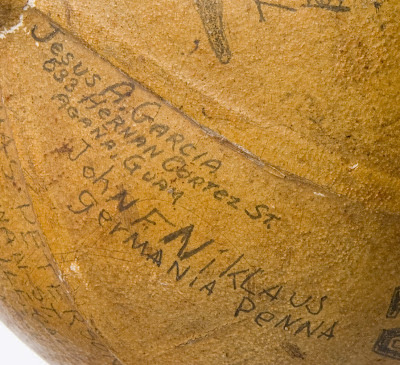
 
Jesus Garcia signed just above John Niklaus.  Niklaus was the first of the Helmet signers to die. Courtesy Glen Binge Family
The first of the helmet signers to die was John F. Niklaus of Germania, Pennsylvania on January 26, 1943.  Japanese records claim he died of "acute pneumonia."  Julius Larson of Healy, Idaho, was next on February 18th.  James H. O'Neal of Worland, Wyoming followed on February 27th.  The Japanese listed the cause of death for O'neal as "cardiac beri beri."  Acute pneumonia also claimed Andrew Nygard of Long Island, New York on March 13th.
Thirty one year old Lester Meyer of San Francisco, California failed to salute a Japanese guard.  He was beaten with clubs and rifle butts off and on for three days.  He died on April 29, 1943 as a result of this torment.  The Japanese listed Meyer's cause of death as "right pleurisy."

Dick Myers was beaten to death on April 29, 1943. Courtesy Glen Binge Family

The next to die was Ted Hensel on May 5, 1943.  Hensel was the man who convinced Logan Kay and Fred Stevens to surrender back on Wake Island.  Norman Hill of Clarkston, Oregon succumbed to "malnutrition" on June 4, 1943.  The last of the helmet signers to die at Fukuoka No 18-B was Lloyd Kent of Burbank, California who passed away on March 3, 1944.

Thirty-seven year old Oreal Johnson of Boise, Idaho served as the chaplain and lay preacher for the Wake Island men.  He provided a short service for each funeral and sang I Need Thee Every Hour. Johnson and other men of the burial details were rewarded for their loathsome duties with extra food.  The guards enjoyed tossing the rice balls among the starving men to see the melee that would ensure.  By April 17, 1944 when the Wake Island men were moved to Fukuoka No 1, Fifty-three of the original 260 were dead. 

Rodney Kephart and Oreal Johnson survived Fukuoka #18. Johnson served as Chaplain during funerals of fellow POWs.
Courtesy Glen Binge Family


Fukouka No. 1 was a large camp that housed American, Australian, British and Dutch POWs.  Conditions improved to some degree at No. 1.  The rations were still sparse, but some Red Cross packages did get through.  The Japanese guards more often slapped their charges around instead of beating them with clubs.  The biggest difference was the nature of the work.  They built a new airfield at No. 1 and avoided the backbreaking labor that had killed so many men at the Soto Dam. 

The death rate plummeted and no more signers of Glen Binge's helmet met their end after leaving Fukouka N.18-B.  Binge also began to make friends outside his Wake Island family at No. 1.  Gunner William Davis, and Sgt Benjamin Regan, both from London and veterans of the Royal Artillery, added their names to the helmet.  The outside was covered with autographs, so they scrawled their names on the inside of the crown next to where Glen had placed his own mark so many months before.  Dutch soldiers, H. Buys, W.F. Zonneaberg and P. Van Veen signed near their British allies.  By enlarging his network of friends outside of his immediate circle, Binge also broadened his potential access to resources.  This may have contributed to his survival.

William Davis of London England was one of five allied
soldiers who signed Binges Helmet. Courtesy Glen Binge Family
 
"Can you make us an American Flag?"

 
During the last year of the war the surviving men who were evacuated from Wake in September 1942 began to be separated.  Labor details were dispatched away from Fukouda No. 1 without regard to the men's original organizations. 

In late August 1945 red, white and blue parachutes began floating to earth above food cartons at Fukouda No.6 near Orio, Japan.  Japan surrendered and hostilities ceased on August 15th.  American bombers began parachuting food and clothing to the starving allied POWs at camps all across Japan.  On the morning of September 1, 1945 several of the officer POWs approached Rodney Kephart with an armload of silk canopies.

"Can you make us an American flag so we can have a official raising of the colors at the same time the Japanese sign the surrender tomorrow morning?" they asked.  The POWs had learned that the official surrender ceremony was to take place the following day.  Kephart was the only man who knew how to operate a temperamental Japanese sewing machine at the camp.  Kephart and another POW, worked sixteen hours straight to have the flag ready in time.  He was too exhausted and overcome with emotion to attend the ceremony.  He lay in his bunk sobbing as his flag was raised over the camp.

Rodney Kephart's flag made from parachutes.
From:   ttp://home.comcast.net/~winjerd/Kephart.htm


Logan Kay and Fred Stevens, the men who hid out for so long on Wake, somehow managed to remain together.  They were liberated on September 19, 1945 at Camp No. 23 at Izuka, Japan.  George Weller, a war correspondent for the Chicago Daily News accompanied the liberation teams and met Kay at Camp No. 23.  Weller recorded Kay's remarkable story and transcribed the diary he kept while on Wake.  Weller and Kay were photographed with a white sun helmet that bore the names of Wake Island dead.  Much like Glen Binge, Kay had saved his own souvenir helmet that bore the names of scores of Wake Island men.  That photograph was published in the Chicago Daily News with the caption "Memento of Terror." It is not known if Scotty Kay's sun helmet has survived.


From:  http://www.historylecture.org/wakeisland.html


As the survivors of the hell camp at Fukouka N.18-B began their long journeys home to the United States, they did not know that all ninety-eight of their comrades left on lonely Wake Atoll had been dead for almost two years.