Friday, November 2, 2012

World War II Skeleton Still Carries Secret Code

Skeleton of a carrier pigeon, that is!

Reblogged from:  http://abcnews.go.com/blogs/headlines/2012/11/wwii-carrier-pigeon-finally-delivers-secret-message/

WWII Carrier Pigeon Finally Delivers Secret Message


Secrets from World War II may have been found in a coded message attached to the skeleton of a carrier pigeon found in an English chimney.

The bird was found when David Martin in Bletchingly, Surrey, was renovating his fireplace.

Martin told the BBC that he began “pulling it down, pulling it down…then the pigeon bones began appearing one by one by one. Down came the leg with the red capsule on with a message inside.”


Martin called the discovery unbelievable and his wife was so delighted with the 70-year-old surprise she said it was like “Christmas.”

Theories suggest the bird was making its way from behind enemy lines, perhaps from Nazi occupied France during the D Day invasions heading toward Bletchley Park which was Britain’s main decryption establishment during World War II.

Others say the bird likely got lost, disorientated in bad weather or was simply exhausted after its trip across the English Channel and landed in the Martin’s chimney.


More than 250,000 carrier pigeons were used in World War II. They were called the National Pigeon Service and were relied on heavily to transport secret messages.

During the war the Dickin Medal, which is the highest possible animal’s decoration for valor, was awarded to 32 pigeons, including the United States Army Pigeon Service’s G.I. Joe and the Irish pigeon Paddy.

Government code breakers are working to read the message found in Martin’s chimney.
Colin Hill from the Bletchley Park pigeon exhibition told BBC, ”I thought no way on earth can I work this one out.”

They have determined so far that the message is from a Sgt. W. Stott and that it was written 70 years ago.
 
A more detailed version of the story can be found here: http://swns.com/news/wwii-carrier-pigeon-secret-code-defeating-nazis-70-years-later-chimney-26984/

Thursday, November 1, 2012

With the Black Scarves at Bong Trang - Part 2


“The First Infantry Division Headquarters named it the Battle of Bong Trang, but those American soldiers who made war there will always call it 25 August.  That is the day in 1966 that my unit fought the Phu Loi Battalion. . .” William J. Mullen III
Captain William Mullen’s Charlie Company of the ½ Infantry was not technically surrounded, although fire was coming from all directions.  But Mullen was not in a defensive frame of mind.  He continued to press the attack in areas of his line and asked his Battalion Commander, Major Richard Clark, to hold off on the reinforcements so that close air support and artillery plaster the enemy.  Major Clark, who could see more of the fight unfolding from a helicopter, declined Mullen’s suggestion and hurried his A Company and B Company to the rescue.  Clark remained in the air where he could see and control the entire fight.  Troop C of the ¼ Cavalry also linked up with B Company for the race to the sound of the guns. 
C Troop of the 1/4 Cav move out on the morning of August 25
From: http://quarterhorsecav.org/pg4g1.htm
Charlie Company had been fighting for almost four hours before Captain Johannsen and B Company found their way through the tangled jungle and into the clearing.  Only the sound of firing and circling helicopters allowed Johannsen to find his way to the beleaguered Mullen.   Heavy automatic weapons fire and mortars pinned them down almost immediately.  Captain Johannsen was wounded by grenade fragments and his intelligence officer, Captain George Downs, took command.  B Company made three unsuccessful attempts to break through to Charlie Company.  Only fourteen men made that last charge.  By then, Captain Downs was wounded and the battalion communications officer, who accompanied B Company, was in command.

Eventually the C Troop of the ¼ Cavalry broke through in their tanks and APCs.  Captain Slattery of the Cavalry found dead and wounded littering the ground and that men had become separated from their platoons and squads.  Hank Stewart of the 1/4 Cav recalled, "2 tracks from C Troop had been knocked out by RPG and 57 recoilless. The crews were all dead. We took up forward positions and our one tank began firing canister into the base camp. We returned fire with .50 cal and M60s. The platoon leaders TC, Sammy Larkin was killed. Lt. Klippen shouted over the radio to "burn the piss out of those treetops".  He was killed right after that."


The 1/2 Infantry Black Scarf worn by PFC John Johnston in Vietnam
An Air Force medivac helicopter had already been shot down in the clearing, blocking the small landing space.  Slattery suggested to Mullen that the wounded be evacuated to a landing zone 400 meters to the east of the clearing.  The Cav’s APC were put into service as ambulances and began shuttling the wounded to the new landing zone.  More medivac helicopters, still landing under sporadic fire, transported them out of the fight to safety. 


Harry Guenterberg rode into the clearing with B Company about noon on August 25.  He was one of only 14 men still standing after his Company made three assaults trying to break into to assist C Company. Harry was also present at the genesis of the black scarf.   He watched Ltc Prillman tear a square of  black cloth from a table in a VC hut to make a sweat rag to go around his neck. That gave the commander the idea for making a scarf for each of his soldiers from a stockpile of captured VC black cotton.   Photo courtesy Harry Guenterberg
 Five hours into the fight and still a cohesive perimeter had not been carved out of the chaos.  The Phu Loi Battalion was tenacious.  The smaller American force was just as determined, but the pressure was too great to consolidate their position.  COL Sydney Berry, the Brigade Commander was impatient.  He ordered Major Clark, the ½ Battalion Commander to take charge on the ground.  Clark and Berry’s UH-1s arrived at the landing zone almost at the same time, and they headed on foot to the clearing together.  As they huddled together to discuss their plans a blast of machine gun fire sent them sprawling.  Berry was unhurt, but Major Clark was dead with a bullet through the skull. 
Although it was a battalion level fight at that time, the Brigade Commander felt he had no other choice but to take command on the ground.  Colonel Berry later recalled that he “ran around like a crazy man getting things moving.”  Because he could no longer see the big picture, he had his Operations Officer who was orbiting in a helicopter, coordinate fire support and move reinforcements to the fight. 

The fight intensified as Berry’s other battalions arrived on the scene and entered the battle.  The 1/26 overwhelmed enemy positions on the east flank; 1/16 Infantry attacked from the west and 2/28 Infantry set up a blocking position to the north of the clearing.  As the 1/26 and the 1/16 made initial gains, Colonel Berry ordered them to shift their axis of attack to link in with Captain Mullen’s ½ Infantry who were still being “chewed to pieces.”  Mullen recalled “Captain Jim Madden, commanding B Company of the 26th, one of the first units to fight its way into our location, received a serious wound almost as soon as he reached us.  He nevertheless broke away from the medics in order to apologize to me for having to leave the fight.”
From: http://quarterhorsecav.org/pg4g1.htm

The 1/16 turned north and immediately encountered a well camouflaged bunker system with interlocking fire.  Viet Cong Heavy machine guns, recoilless rifles, mortars and small arms raked A Company.  Within minutes the commander, Captain Peter Knight, was killed and all of his platoon leaders wounded.  1/16’s attack ground to a halt, but as they reorganized the enemy in their immediate front fled from their positions.

As the 1/16 Infantry’s attack wound down, Ltc Paul Gorman commander of 1/26 Infantry, arrived in the clearing with the last of the American reinforcements.  Berry’s entire brigade was now in contact with the enemy.  As Gorman made a triumphant entry on a M48 tank, Berry climbed aboard to shake his hand.  “A machine gun opened up on us, and we unceremoniously scrambled off the tank, dashed across the clearing, and jumped into a VC trench I was using for my CP,” Berry recalled.  Berry left Gorman in command on the ground and returned to resume control of his brigade. 
Night falls quickly in the jungle.  As darkness enveloped the Americans they hunkered down and allowed artillery and a flare ship to keep the battlefield illuminated throughout the night.  The Phu Loi Battalion made no further coordinated attacks.  They were satisfied to wait for an attack in their underground bunkers and send sporadic harassing fire into the American lines.

The early morning of August 26th found Colonel Berry back on the ground at the clearing.  The enemy was still hunkered down in their bunkers.  He wanted them out of the ground where he could kill them, but did not want to send his battered troops in a frontal assault to root them out.  Too many good men had been lost the day before.  Berry and Ltc Gorman decided to call a napalm strike in the bunker system sandwiched between his 1/16 and 1/26 Infantry battalions.  The eleventh canister struck a tree and sent jellied flames across Gorman’s CP, burning a map from the scrambling commander’s hands.  "My map and radio were literally burned up," Gorman remembered, "and I got singed a bit.  I asked that they keep laying the napalm on, and they did."  Gorman watched helplessly as a later canister fell short, into the American lines.  Two Americans died and fourteen were injured in the flames. 

John Johnston recalled the incident.  "Our Air Force dropped napalm on us because some dumbass threw a red smoke grenade out when we marked our position with smoke.  When they dropped the napalm, the gooks left."  Gorman halted the air attacks.  Despite the horror of the American casualties, the napalm had done what was intended.  The Phu Loi Battalion was retreating and leaving their base camp to the 1st Brigade. 
The 1st Brigade spent the remainder of the day mopping up VC stragglers as they scoured the jungle north and east of the clearing.  Early in the day, nine men from the original lost patrol limped into the landing zone.  They had survived by hiding deep in VC bunkers with the  enemy all around them.

John Johnston lived through the twenty four hours of hell that was August 25.  Like many of the men who survived this fight, it is still burned into his psyche.  John later became the "RTO" and carried the platoon sergeant's radio.  He performed the same service for his platoon leader before he was offered a job in the Brigade mail room for his last month in country.  He turned it down ". . .because I was too proud to quit.  I told them about another guy who needed it worse than I did."  John received a Bronze Star for valor for his actions on August 25th.  His citation reads in part: 

Private First Class Johnston noticed a claymore mine set up in the path of his advancing comrades.  Realizing the imminent danger, he courageously rushed forward into a heavy barrage of mortar and automatic weapons fire and deftly disarmed the mine.  Later in the same afternoon, PFC Johnston personally led several members of his platoon in a grenade assault of Viet Cong occupied trenches and bunkers.  They were successful in routing the enemy.

John told me many years ago that "deftly disarmed the mine" meant that he laid the electrical wire across the butt of his M16 and hacked it with his bayonet!  It worked. 
18 year old PFC John Johnston (left) wears his newly won Bronze star with other veterans of Bong Trang. 
Photo Courtesy of the John Johnston
 Johnston was one of many men who were decorated for actions at Bong Trang.  Captain William Mullen and Ltc Paul Gorman were awarded the Distinguished Service Cross.  Mullen, Gorman, and Berry all became general officers later in their careers.

Captain William J. Mullen III receives his Distinguished Service Cross from General William Westmoreland
during a ceremony after the battle of Bong Trang.  Probably one of the few times were a 1/2 Infantry
 black scarf was cleaned and pressed!  Photo from:  http://www.legionofvalor.com/citation_parse.php?uid=994197960
All battles come with a human cost.  For Vietnam War standards, August 25 was a murderous day.  The 1st Brigade of the First Infantry Division lost 43 killed and 248 wounded.  C and B Company of 1/2 Infantry sustained the lion's share of these losses.  Captured documents later revealed that the Phu Loi Battalion lost 171 killed at Bong Trang and their wounded filled VC medical facilities in the region.
AUTHORS NOTE:  I have one other connection to this story.  When I served with the First Infantry Division in the early 1980s, Colonel William J. Mullen III was my Brigade Commander.  Colonel Mullen was well liked and respected by his officers.  His part as a young captain in this battle so many years before, and the fact that he was a recipient of the Distinguished Service Cross (second only to the Medal of Honor in precedence) was unknown to us.  He was a level headed and humble commander, who expected the best from his men.

Thursday, October 25, 2012

One Black Regiment’s Victory Over the Enemy and the Prejudice of Their Comrades

AUTHOR'S NOTE: The second part of "With the Black Scarves at the Battle of Bong Trang" will be presented in my next blog post. Tomorrow is the 148th anniversary of an important historical event that occurred near my home.  So I will offer this story to coincide with that anniversary.

I published a slightly different version of this article in "The Bugle - The Journal of the National Infantry Association" in 2011.  Thanks to my friend Doug Cubbison who did most of primary research for this article.
 
The Charge of the 14th USCT at the Siege of Decatur, Alabama
October 26, 1864
 

"History has not yet done justice to the share borne by colored soldiers in the war for the Union.  If the records of their achievements could be put into such shape that they could be accessible to the thousands of colored youth in the South, they would kindle in their young minds an enthusiastic devotion to liberty and manhood.”  The words of COL Thomas J. Morgan, written almost 150 years ago, still ring true today.

COLONEL THOMAS F. MORGAN
 
Morgan knew of the courage and devotion of men of color first hand.  Morgan, a 23 year-old Major at the time, helped to organize the 14th Regiment of United States Colored Troops (USCT).  This regiment was part of 180,000 African American men who answered the call to save the Union and free their fellow slaves from the horrors of the "Peculiar Institution." 

 
After the Emancipation Proclamation in January 1863, the US Army began the organization of black regiments.  Thousands of young black men fled from farms across Tennessee and Northern Alabama to answer the call.  The 14th USCT was one of seven black regiments organized in Middle Tennessee in the late fall of 1863.  White volunteer regiments were commanded by officers who were politically appointed by their home states, often without experience or military training.  In contrast, USCT regiments were commanded by white officers, but those assigned to USCT units had to pass exhaustive tests on tactics, military discipline and logistics. It was considered a privilege to lead black troops.  Only the best candidates were allowed to have that responsibility. 

 
The regiment guarded supply lines around Chattanooga and Northern Georgia for the first eight months of its career and had its baptism of fire at a skirmish near Dalton, Georgia, in August 1864.  The following October, John B. Hood's Confederate Army of Tennessee left Georgia and began a move towards middle Tennessee in an unfruitful effort to lure away Sherman's army from its famous march from Atlanta to the sea.  Hood knew that only scattered garrison units stood in his way and that he had to strike quickly towards Nashville before an effective combat force could be formed to oppose him.  Hood crossed into northern Alabama and raced towards Decatur, Alabama, where a strategic rail and pontoon bridge offered the closest point to cross the Tennessee River.

Brig. Gen. Robert S. Granger cobbled together a force of about 4,000 men, made up of garrison and newly recruited regiments, to block Hood’s crossing at Decatur.  The 14th USCT was rushed from Chattanooga by rail.   They were added to a feverish effort to prepare the defense.  Two earthen redoubts and over 1,600 yards of rifle pits were dug around the little town in only two days of preparation. 

 The Confederate Army encircled the town on October 26, 1864 with 39,000 troops.  Rifle fire and artillery crashed for three days in a Rebel effort to destroy the garrison and force a crossing of the river.  The Federals held their ground behind their earthworks, but the artillery fire became unbearable.  Six Confederate guns near the river were especially effective.  The Union commander sent a message to the 14th USCT, who occupied that part of the line, to silence the Rebel guns.  The former slaves would have to cross 450 yards of open ground, directly into the fire of the six cannon.  COL Morgan remembered “They manifested no undue excitement or fear, but seemed anxious for the work.”


Captain Henry Romeyn later won the Medal of Honor in 1877
during the Indian Wars.
 
Morgan ordered the assault to begin at noon. Captain Henry Romeyn of Company B recalled: “…The order was at once given to charge, and with arms at the right shoulder 363 enlisted men and officers rushed to the assault. It required but little time to reach and go over the slight works, and driving off the artillerymen (to) spike the guns.”  Men of the 14th drove files into the touch holes of the cannon, rendering them useless to the enemy.  An overwhelming Confederate counter-attack and a hand-to-hand melee around the guns forced the Union solders to retreat back to their fortifications, under a shower of rifle bullets.  They succeeded in bringing all their dead and wounded with them - no man was left behind.  Cheering greeted them as they returned, and the men knew they had finally gained the respect of their white countrymen.


The mission was a success; the guns were disabled and silenced.  The next day Hood’s Army abandoned its effort to cross at Decatur and marched up stream to Florence, where high water delayed their crossing even longer.  The Union stand at Decatur and the gallant charge of the 14th USCT provided vital time for General George H. Thomas to concentrate two corps of Federal troops to defend middle Tennessee. 

A soldier from the 102nd Ohio recalled of the 14th: “They are a splendid regiment of men, and would fight the devil if he would come at them in the shape of a ‘Johnny Reb’.”  The commander of the 18th Michigan wrote: “The charge was most gallantly and successfully made.  All honor to the colonel and his brave regiment of colored troops.”
 
Captain Romeyn later recalled: “. . . the white soldiers mounted the parapet and gave three rousing cheers.  I shall never forget the glad look of my first sergeant as, marching by my side, he turned his face to me and said ‘Captain, we’ve got it at last.’  Our victory was complete.”


An unidentified African American soldier of the USCT


Wednesday, October 24, 2012

With the Black Scarves at the Battle of Bong Trang


1st of the 2nd, The Black Scarf Battalion


In April 1966, Sgt. Harry Guenterberg watched Ltc Richard Prillaman tear a square of black cloth from a table in a VC hut to make a sweat rag to go around his neck. That gave the commander an idea.  American soldiers working in the tropic climate of South Vietnam often wore green towels or cloths around their neck to keep the flowing sweat under control.  Although the practice was “non-uniform” it was tolerated by leaders.  The village of Lo Go, that Prillaman and his troops had just captured, harbored a large stash of black cotton cloth, destine to be fabricated into black pajama Viet Cong uniforms.   Ltc Prillaman, commander of the 1st Battalion, 2nd Infantry Regiment, took the cloth and had it made into something useful, but distinctive.  The whole battalion would soon sport uniform black neck scarves. 
 
Someone suggested distinctive company embroidery and developed a color scheme to go with it: HHC - yellow, Company A - red, Company B - white, Company C - blue and Company D - green.  So was born the Black Scarf Battalion.  The battalion continued this tradition until they re-deployed to the United States in 1970.   (From "2nd Infantry Regiment" by Larry Grzywinski, http://www.secinfreg.org/2nd%20Infantry%20Regiment%20for%20the%20web%20site(01162015).pdf)


LTC Richard Prillaman.  Prillaman went on to command an Armor Division during the 1980s.
He retired as a  LT General.  Photo courtesy Stanley Richards.


1/2 Infantry, Black Scarf soldiers clean thier equipment after an operation. 
Photo courtesy John Johnston

 A Treasure Re-Found

Thirty one years ago I was new 2nd lieutenant getting ready to ship out to the First Infantry Division.  The "Big Red One" had a storied history from WWI, WWII and Vietnam.  I was very proud to have been assigned to that famous division. 

 Greg McMahon and Curtis Quickle, my best home town buddies, took me out for a last fling in Little Rock before I departed for Fort Riley, Kansas.  At one of our stops, I ran into a gentleman who sported a First Infantry Division pin on his cowboy hat.  Next to the division pin was a unit crest for the 1/2 Infantry  -  the battalion in the First Division where I was to be assigned! 

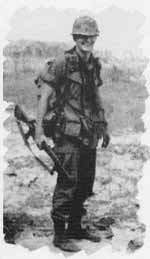
 I hailed him of course, and we struck up a great conversation.  John Johnston had seen combat with the 1/2 Infantry in Vietnam.  I got his address and we corresponded for several months after that.  I felt truly humble, and privileged when he gave to me the Black Scarf that he wore in Vietnam and photos of himself taken in country.

 I treasured those artifacts, but during one of my many military moves they were lost - or so I though.  I   mourned the loss of those items for many years, until they recently resurfaced when I found them tucked away in a long forgotten box. 

 This is the story of John Johnston and the Black Scarf Battalion at the Battle of Bong Trang, one of the fiercest battles of the Vietnam War.
"C Company weren't culls on 25 August, 1966.  C Company and B Company were wiped out that day."

At the peak of the Vietnam monsoon season, the 1st Brigade of the 1st Infantry Division began a routine road clearing operation.  Operation Amarillo, as it was called, was intended to remove mines and IEDs along several roads in Binh Long and Binh Duong Provinces.  Most of the clearing would occur along Highway 16 between Phuoc Vinh, the brigade base camp, south to Di An, the division headquarters.  The first two days were uneventful.  On the night of August 24th, Capt William Mullen sent out a fifteen man patrol from C Company, 1/2 Infantry.  They were to stay over overnight and listen for potential movement of enemy forces.

The next day dawned clear, a respite from the monsoons.  The patrol soon walked into the middle of a North Vietnamese base camp, that until that time had remained undetected.  As the patrol realized their mistake, they sent out an urgent call for help.  Within minutes half were dead and the survivors were fighting from abandoned NVA bunkers.  Five hundred men of the Phu Loi Battalion of the NVA army were swarming to the attack.  Only artillery fire called in on their own position by the patrol kept the enemy at bay.

Pvt. John Johnston of Little Rock, Arkansas was a baby faced 18 year old rifleman in C Company.  He, along with the remainder of C Company and a platoon of the 1st Squadron, 4th Cavalry Regiment (1/4 Cav) loaded on one M48 tank and seven M113 armored personal carriers and sped to the rescue.  As the relief force neared a large clearing in the NVA camp, the enemey ambushed C Company. 

Photo courtesy of John Johnston
Lt James Holland, on his first combat operation as a platoon leader remembered, "When we were about 400 meters from them all hell broke loose. We deployed off the cav vehicles and we all returned fire. Our fire suppressed the VC and my company commander told me to take an A Cav and a tank, mount my platoon and go get the squad. We pulled out of the perimeter and headed for our objective. When we were about 400 hundred yards out the company and the vehicles we left were hit hard. I was ordered to return. As we turned the tank threw a track. Because it would have taken to long under those conditions to repair it we had to leave it. After destroying it we headed back in to the fight."  Lt Holland was wounded and three of his vehicle commanders were killed immediately as mortar and heavy machine gun fire tore through the column.  Casualties mounted as C Company engaged the Phu Loi Battalion. 
Lt James Holland. From:
http://www.leonflpurpleheart.org/Patriot.Holland.htm 
As the leader of Troop C's 2d Platoon, Sgt. Wilbur J. Barrow, reported, "Every time we tried to get out, we were hit by mortars and hand grenades." As the commanders fell, Barrow continued, "privates were taking command of the tracks and calling  me to ask for help. My answer to them was to pick up their wounded and take salt pills and drink water, and pray, pray, pray! There was no help for anyone.”


"We were in their base camp and they wanted in and we didn't let them."

 The fight turned into a close quarters slug fest.  Only artillery support saved Mullen's force from being overrun.  Mullen remembered later: "Until 2nd Lt Bruce Robertson, our forward observer was evacuated, he called for artillery fires on a continual bases, despite blood spurting from numerous wounds."

 Casualties continued to mount, and no one knew how long it would take for help to arrive.  Mullen recalled: "While talking on the radio, I heard someone say, 'Charlie Six.' I looked up to see Specialist Tommy Freese, the only man in his platoon who was not a casualty.  As bullets few all around, Tommy stood in the open with a 60mm mortar on one shoulder and a sack of ammunition on the other. 'Sir' he said.  'The fourth platoon is ready.  Where do you want me to shoot?' "

From: Combat Operation: Stemming the Tide - May 1965 - October 1966. 
John M. Carland, Office of the Chief of Military History, Govt Printing Office
Pvt John Johnston paints a vivid picture of the fight. "It was a bad day that burned in my mind.  24 hrs of fear despair and anger.  We shifted around all day, trench to trench.  I used lots of grenades.  There was a continuous roar.  Gunpowder and the smell of soured blood.   Powder burns on my arms from buddies weapons.   Hot rifle shells going down my collar.  Hot.  I don't know how we survived."

 Now C Company and the cavalry needed to be rescued.  The remainder of 1/2 Infantry was committed immediately and raced to the fight.  Soon, the Brigade commander had all of his battalions moving to the NVA base camp.  1/16 Infantry, 1/26 Infantry, 2/28 Infantry and the remainder of 1/4 Cavalry were moving to the sound of the guns in a hasty attack.

 Help was coming, but could Charlie Company hold out? 

Next time:  Part two http://erasgone.blogspot.com/2012/11/with-black-scarves-at-bong-trang-part-2.html

Monday, October 15, 2012

A Real Buffalo Soldier

I had the privilege of meeting a genuine Buffalo Soldier recently.  Most people associate that moniker with the old African American 10th and 9th Cavalry who served on the western frontier in the late 19th Century.  But another generation of Buffalo Soldiers served during World War II.

The US Army’s 92nd Infantry Division was the only all black division to serve in the European Theater of operations during World War II.  The 92nd proudly displayed their Buffalo Soldier heritage with the “buffalo” shoulder patch.

When I visited Harper’s Ferry Historic Site this week, I ran into this gentleman.  He had just returned from the reunion of the 92nd Division that was held at Silver Spring, Maryland. 
Mr. James Daughtery and myself at Harpers Ferry.
Photo by Phyllis Hubbs
  Mr. James “Pat” Daugherty was one of the youngest survivors of the 92nd who attended the reunion.  He is 88 years old.  His ball cap proudly displayed the 92nd’s buffalo patch, a Bronze Star and Combat Infantryman’s Badge. 

Mr. Daugherty deployed with his division to Italy in August 1944, and fought against the Germans there until the end of the War.  Between August 1944 and May 1945 the 92nd Division suffered 3,200 casualties.  Unlike white infantry divisions, the 92nd received no replacements as the War progressed as there were no African American infantrymen in the replacement pipeline, and the Army would supply no white troops to fight shoulder to shoulder with the blacks.
It was only after my meeting with Mr. Daugherty that I discovered that he was a celebrity in his own right.  Mr. Daugherty wrote an account of his experiences during the War and his disappointing return to the discriminatory Jim Crow laws of his home state of Maryland.  He wrote this down by hand in 1947.  At the urging of relatives, he published his memoirs as The Buffalo Saga in 2009. 

Daughtery went on to study at Howard University in Washington D.C. on the G.I. Bill and to work as an administrator in the U.S. Public Health Service.  He overcame Jim Crow to become the first African-American to serve on the board of the Montgomery County, Maryland Public Schools.  July 28 is now officially “Buffalo Soldier James Daugherty Day” in Silver Spring, his home town.

Smithsonian Magazine published an article about him and his book that year.  You can see it here: http://www.smithsonianmag.com/history-archaeology/Memoirs-of-a-World-War-II-Buffalo-Soldier-.html

A series of interviews with Mr. Daughtery were filmed soon after his book was published.  In the first, he shows his beloved “steel pot” helmet and the mortar shell fragment that almost killed him.  http://www.youtube.com/watch?v=YUVBk-2nwj0
Mr. Daugherty told me about being contacted by film director Spike Lee.  Lee took the old Buffalo Soldier scouting for locations in Italy to shoot his film “The Miracle of St Anna” which told the story of the World War II Buffalo Soldiers. 

He recalled to me:  “They took me to the cemetery in Italy and I saw all those markers lined up in neat rows.  There were lots of boys left there.  Sometimes I wonder why they all had to die.”

Thursday, October 11, 2012

The Hating has to Stop - The "Railway Man" dead at age 93


'Some time the hating has to stop': A tortured war hero, his Japanese tormentor, and the redeeming power of forgiveness.

Re-blogged.  See the complete story here: http://www.dailymail.co.uk/news/article-2215357/Eric-Lomax-A-tortured-war-hero-Japanese-tormentor-redeeming-power-forgiveness.html

Beaten to a pile of broken bones, caged, starved and tortured, Eric Lomax was convinced he would never see Britain ever again.

He had already experienced the lottery of death among the chain gangs on the Burma-Siam Railway. Now things were even worse. Accused of being a spy, he had been left to the mercies of the Japanese army’s secret police.  Among their specialities was what is today known as ‘waterboarding’, when a prisoner undergoes near-drowning. It was surely only a matter of time before he would be put out of his misery.

As his interrogator had explained to him on arrival at the prison camp in 1943: ‘Lomax, you will be killed shortly whatever happens. But it will be to your advantage in the time remaining to tell the whole truth. You know now how we can deal with people when we wish to be unpleasant.’

Eric Lomax was put to work building a railway by his Japanese captors during the Second World War, before he was accused of being a spy and interrogated by Nagase Takashi (below)


And yet Eric Lomax would somehow survive an ordeal so unspeakable that when he was later transferred to Singapore’s notorious Changi prison, he described it as ‘heaven’.

After the war, like so many of those who had survived the atrocities of Japanese captivity, he could barely discuss his experiences with anyone.

He bottled it all up, although he found that tiny things –particularly inaccurate bills or bureaucratic requests for personal information – could almost paralyse him with fury.


 Through it all, he retained a loathing for the Japanese, particularly the infernal interrogator still haunting his dreams with the same words: ‘Lomax, you will tell us...’  Yet nearly 50 years on, Eric Lomax did something extraordinary. He not only tracked down the man – he met him, befriended him and forgave him. And in 1995, he published a powerful account of his experiences.

Called The Railway Man, it swiftly became a bestseller and won a cluster of literary awards. Indeed, so remarkable is the memoir that it is about to come to the big screen – with Mr Lomax played by Oscar winner Colin Firth, no less –and with Nicole Kidman as his wife.

Sadly, Mr Lomax will not see the film. In the early hours of last Monday morning, he died at his home in Berwick-on-Tweed at the age of 93. He leaves a widow and daughter.


Eric's wife Patti (left) encouraged her husband to get in touch with his erstwhile torturer

 But he also leaves an enduring story of the healing power of forgiveness that will be retold long after we are all gone.
 

Tuesday, October 9, 2012

Wherefore art thou, “Woodden O” - Shakespeare’s pre-Globe theater un-earthed in London

We are all familiar with Shakespeare’s famous Globe Theater.  It has been lovingly reconstructed near its original location on the south bank of the Thames River in London.  But, Shakespeare’s plays were performed at several venues before the Globe was completed in 1599.  Shakespeare’s theatrical company, The Lord Chamberlain’s Men, performed early plays at a theater cunningly named “The Theater.”  When the company had a falling out with the landlord in 1597, Lord Chamberlain’s Men, moved to a smaller, interim venue known as The Curtain Theater, named for Curtain Close, a road in East London. 

William Shakespeare

Scholars agree that two of the Bard’s most famous plays, Henry V and Romeo & Juliet, were first performed at the Curtain.  The opening lines of Henry V make reference to the Curtain Theater:
Can this Cock-Pit hold
The vastie fields of France? Or may we cramme
Within this Woodden O. the very Caskes
That did affright the Ayre at Agincourt?

The Curtain Theatre opened in 1577 not far from “The Theatre” and was one of a number of early theatres built outside the City of London’s city walls. This was the main venue for Shakespeare’s plays between 1597 and 1599 until the Globe was completed in Southwark. The Curtain Theatre disappears from the historic record in 1622.  Eventually, it was dismantled and its exact location forgotten.

The area of London were the Curtain was thought to stand, is now one of the most built-up areas of London.  Was there even an open place to dig for it?  A tiny gravel yard behind “The Horse and Groom,” a popular pub in the Shoreditch area of London, offered the only place to excavate.


The gravel yard behind the "Horse and Groom" pub in Shoreditch.
Experts from Museum of London Archaeology (MoLA) began exploratory work in June, 2012 and hit pay dirt.  They have found two sections of exterior wall, crucial for giving the dimensions of the theatre, and are confident of revealing more as the site is cleared for redevelopment.  An outer yard paved with sheep knuckle bones could date from the theatre or slightly later housing.


An MoLA archaeologist inspects the remains of The Curtain Theater

The site’s owners, Plough Yard Developments, in conjunction with The Estate Office Shoreditch, now want to make the remains of The Curtain Theatre into the center piece of a new development. The proposals include keeping the remains in place and potentially opening them up to the public via the public space alongside a mix of new homes, offices, shops and restaurants for Shoreditch.  More MoLA excavations will come as part of the redevelopment of this part of Shoreditch.

You can read more about the excavations at the Curtain Theater site here:  http://www.museumoflondonarchaeology.org.uk/NewsProjects/CurtainTheatre.htm